
Eaté Tuscany Review: Fine Dining at The Sense Experience Resort
Discover why Eaté at The Sense Experience Resort is one of Tuscany's best-kept dining secrets, combining exceptional coastal Italian cuisine, hyper-local seafood, refined fine dining and spectacular beachfront views on the wild shores of the Maremma.
Tuscany is a region entirely weighed down by its own reputation. By now, most of us have done the typical pilgrimage: we’ve shuffled along with the neck-craning crowds of Florence, wandered the tourist-heavy vineyards of Chianti, and carb-loaded our way through a cuisine that’s become predictable through sheer repetition. But escape the whistle-stop coach tours and head down to the sun-bleached, pinewood-fringed coast of the Maremma, and the noise begins, quite suddenly, to fall away.
Here, the light softens, diffused across pale sands and low-slung pines, while the sea stretches out in long, glassy sheets of silver-blue. In the distance, the hulking shadows of Elba and Montecristo promise further adventures, but right here, right now, there’s more than enough to satisfy even the most jaded of travellers.
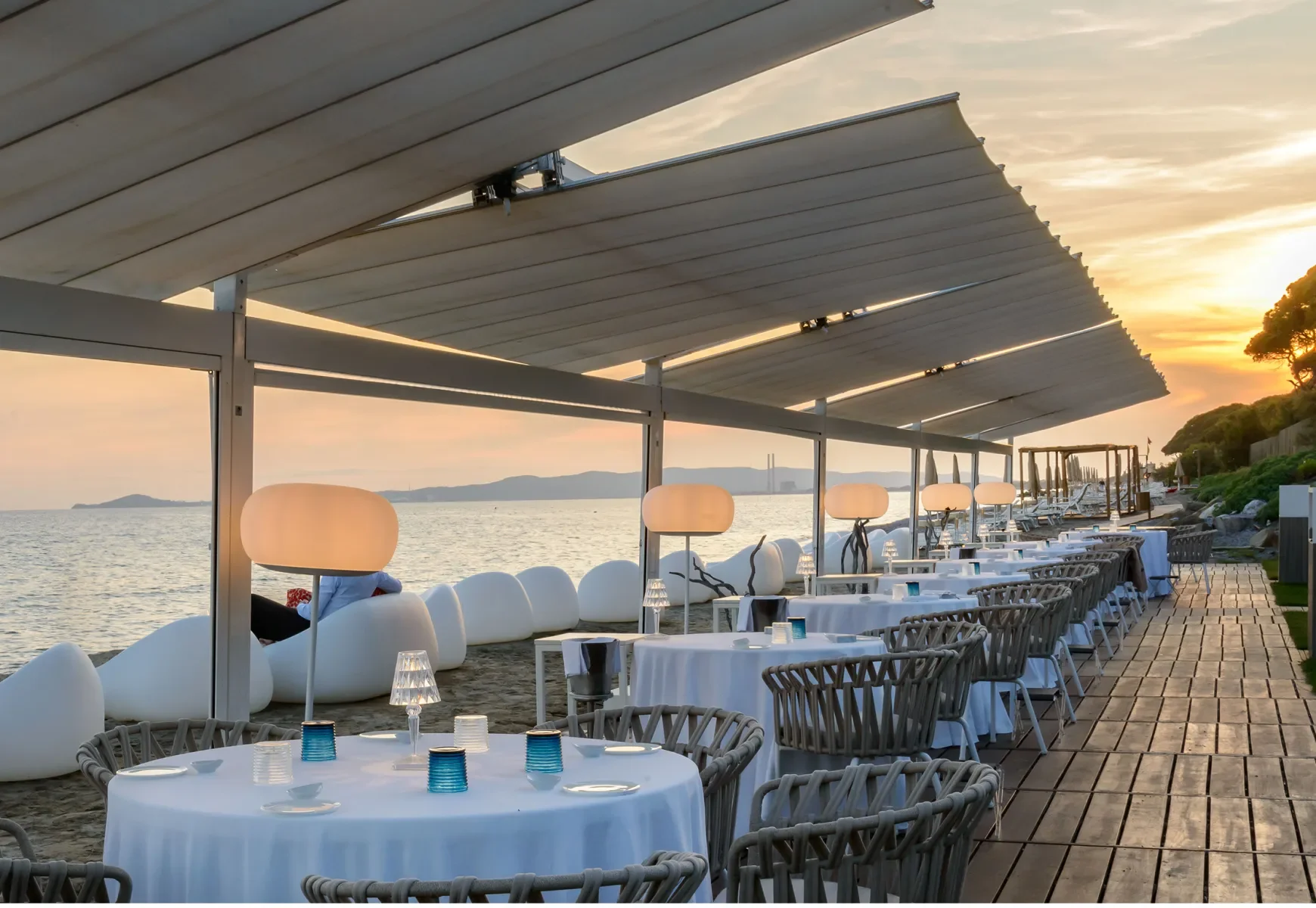
Pristine, romantic dining at The Sense Resort
This is Tuscany’s seaside frontier, presenting an altogether wilder face to travellers. Nestled within the sleek, modernist sanctuary of The Sense Experience Resort—a five-star health-conscious eco-retreat that has caught the attention of the Michelin Guide—lies Eaté. Helmed by chef Giuseppe Parisi, it is a kitchen that operates with a confident, quiet swagger, entirely unbothered by the monumental tourist traps further inland.
Far From Just a Restaurant With a View
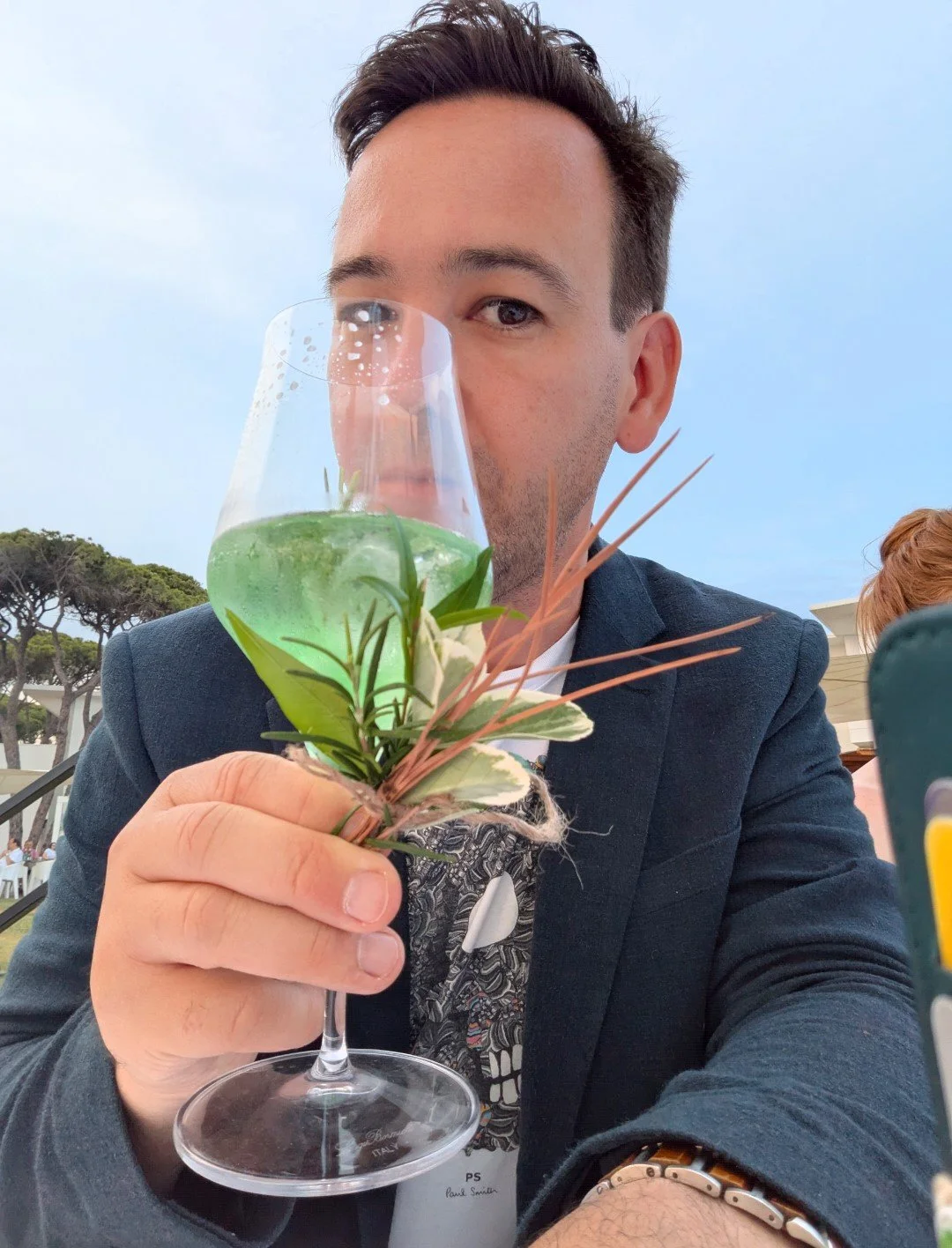
Foraged flavours, served in style
I have long maintained a fierce scepticism when it comes to restaurants with a view, and not without reason. Too often, a dramatic vista is weaponised to camouflage mediocre cookery. At Eaté, however, the landscape is not a distraction but an extension of the plate itself. The restaurant’s signature move is placing a single banqueting table directly onto the pristine sand of its private beach, something which invites diners to take their place within the literal context of the menu. As the summer sun slips beneath the Tyrrhenian Sea, the experience unfolds as something both celebratory and quietly meditative.
Proceedings begin with an aromatic introduction from the sommelier, Vincent: a cocktail infused with a quintet of pungent, bitter herbs, all foraged from the hotel’s re-natured grounds. It carries the scent of the gardens I had just walked through, grounding the evening immediately in its surroundings. Soon after, an amuse-bouche arrives, firing an opening salvo that neatly encapsulates the mission statement of the kitchen. I’m presented with a sour cherry gazpacho centred around a single, wonderfully fat poached prawn from a hyper-local DOP fishery, and it bursts with sweetness and sharp salinity, tasting — quite frankly — the way you wish prawns always would.
A Masterclass in Subversion and Skill
The true test of a kitchen lies in its ability to quietly dismantle a critic’s preconceptions. When the first proper course arrived, I felt a flicker of irritation. I had been promised oysters, and I am a man who can put away raw, shucked bivalves in serious quantities. Instead, they appeared poached, lifted from their shells and set atop a velvety sweetcorn emulsion, split with a vivid leek and herb reduction. It wasn’t what I thought I wanted, which goes to show that my horizons still have some broadening to do.
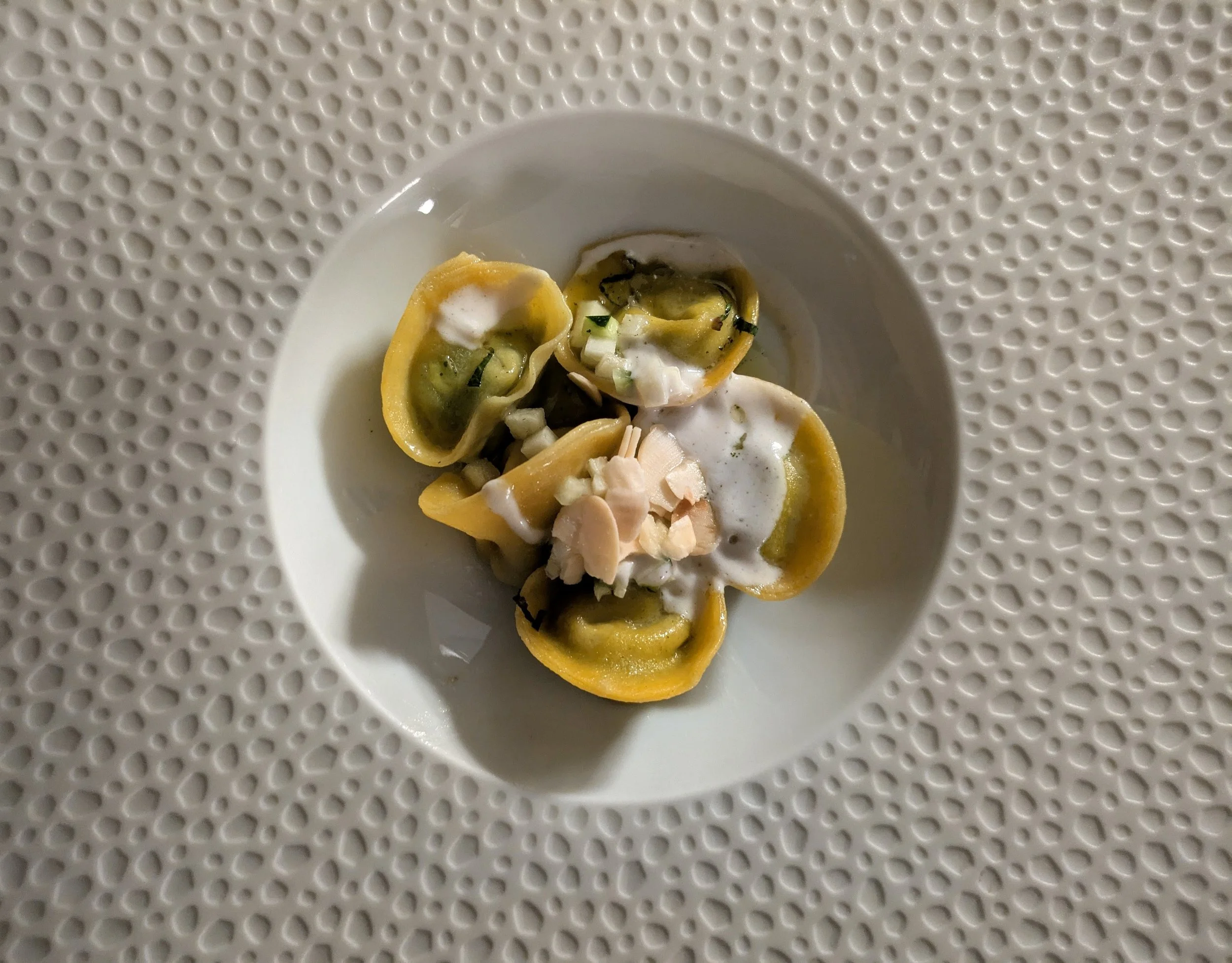
Tortelli a la Eaté
The irritation didn’t last long. Given just a few fleeting seconds of heat, the oysters had been coaxed into something altogether more compelling: still briny and metallic, yet yielding, almost tender, against the warmth of the corn. The balance between the richness of the emulsion and that clean, saline edge was not just clever, but exacting. It was clear proof, if any were needed, that this is a kitchen with a precise understanding of seafood’s natural geometry.
There was, however, a brief misstep. The pasta primo (tortelli with courgette and almonds) arrived with admirable restraint and a lightness of touch, but in the context of what surrounded it, felt a little too delicate to leave a lasting impression. I rarely find pasta dishes the highlight of any course – gastronomic blasphemy when in this part of Europe, I know – but amid the evening’s more assured, expressive dishes, it landed as a moment of caution from an otherwise confident kitchen.
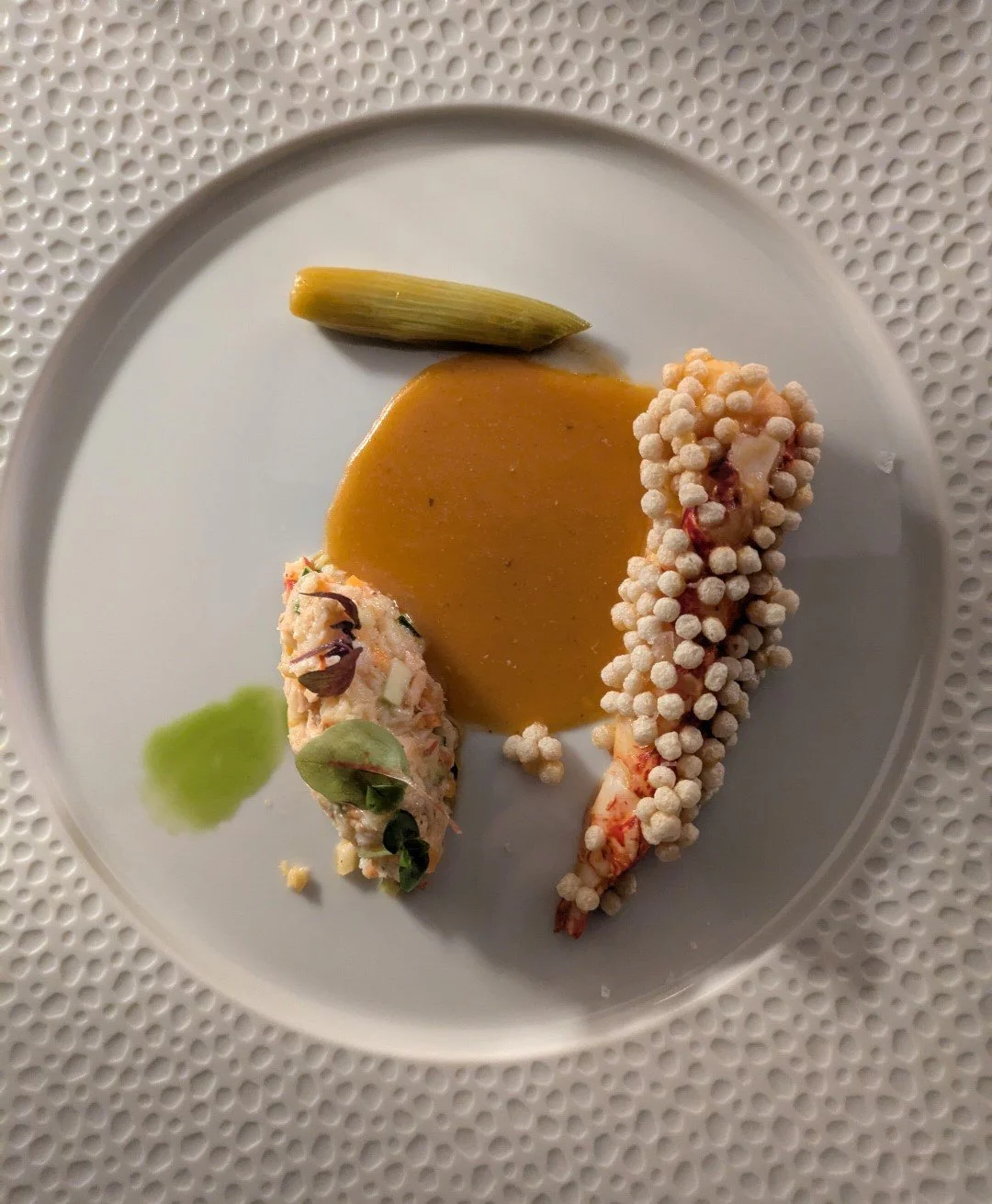
Beautifully judged lobster
Any hesitation was, once again, short-lived. The rhythm returned with the arrival of a beautifully judged lobster, cooked to that precise, translucent point where the meat shifts from raw to something tender and sweet. Parisi offsets the richness of the white meat with the light crunch of puffed rice and the gentle, aniseed clarity of fennel. Sitting there on the open shore, the salt air echoing the flavours on the plate, the vision slipped into crystal clarity: it became difficult to separate the dish from its surroundings, and the line between kitchen and landscape dissolved almost entirely.
A pre-dessert followed: a carpaccio of thinly sliced strawberries, resting in a gentle balsamic reduction, delivering a gigantic thwack of sweet summer flavour to the palate. I could have eaten three.
By the time the final desserts arrived (a loose sequence of chocolate creations, Turkish delight and herbaceous marshmallows) we had long since moved into deeper, heavier bottles of Super Tuscan wine, and they slipped down perhaps without much attention being paid to the hard work that had clearly gone into their creation.
So life goes, and midnight came quietly to lower the curtain on all that had played out on this particular sandy stage. A double espresso and a solitary walk along the surf offered just enough pause to take in the evening as a whole, and all felt right with the world.
A Quintessential Hidden Gem
With Tuscany’s historic heavyweights continuing to dominate the international spotlight, Eaté remains free to exist slightly outside the narrative.
It does not attempt to compete with the region’s institutions; instead, it quietly renders them unnecessary. For those in search of a gastronomic experience removed from the crowds and rooted entirely in place, it stands as an essential reservation.
Want to read more great European restaurant reviews? Check out our reviews of Arte Restaurant Poznan, Marchal Copenhagen, La Table du Couvent Limoges, and Terrace Martinhal Lisbon.
