
Director Wes Anderson is a curious character of 20th and 21st century popular culture, cutting a somewhat Marmite-y figure amid a slew of fellow directors, imitators and acolytes in the pursuit of nailing a truly recognisable aesthetic and narrative tone.
I’m never entirely sure where I sit with him - on the one hand, I massively admire his commitment to his craft and meticulously-curated visual idiom. On the other, I’ve actively disliked as many of his movies as I’ve genuinely enjoyed. The Royal Tenenbaums was a delight, and The Life Aquatic was the epitome of style of substance. I found The Grand Budapest Hotel a work of absolute, re-watchable brilliance, but struggled through Fantastic Mr Fox as an affront to traditional British storytelling. Newer releases, (most notably the occasionally-vapid-sometimes-brilliant Asteroid City) did nothing to change my mind.

“Surprisingly massive” - The Grand Budapest Hotel
However, that’s somewhat beside the point. How many other contemporary and still-working mainstream film directors can you think of who have an immediately recognisable cinematographic style? Robert Eggers springs to mind, with his rabid occult leanings, but very few others. The fact that Wes Anderson carved out a niche so instantly familiar and enduring absolutely is something to celebrate in an otherwise bland, cookie-cutter movie landscape, and that’s precisely the impetus and drive behind Wes Anderson: The Archives, the latest big-name retrospective to land at The Design Museum in London.
The preview of Wes Anderson: The Archives - which will run until 26th of July 2026 - revealed an array of treasures that, perhaps unexpectedly, led me to reassess my occasionally damning attitude towards Anderson’s films; that’s clearly part of the point of the show, as otherwise, it would be little more than a chance for his fawning fans to fawn even further. It’s a peek into the magician’s suitcase, a chance to uncover seven hundred film props that have been kept under wraps for almost thirty years, and a way to view Anderson’s work as a decisive whole and a distinct oeuvre.
The exhibition is fairly chronological - it charts the entire evolution of his style and output, beginning with the short and feature films that captured the heart of indie movie darlings in the nineties, and ends with his most recent productions. There are enough big-hitting props on show to satisfy both hardcore fans and questioning admirers (such as myself); it was an undeniable thrill to see the candyfloss pink and surprisingly massive model of the Grand Budapest Hotel, and I’m always fascinated by storyboards, sketches and mood boards of artists of all stripes, of which there are plenty to explore and uncover.
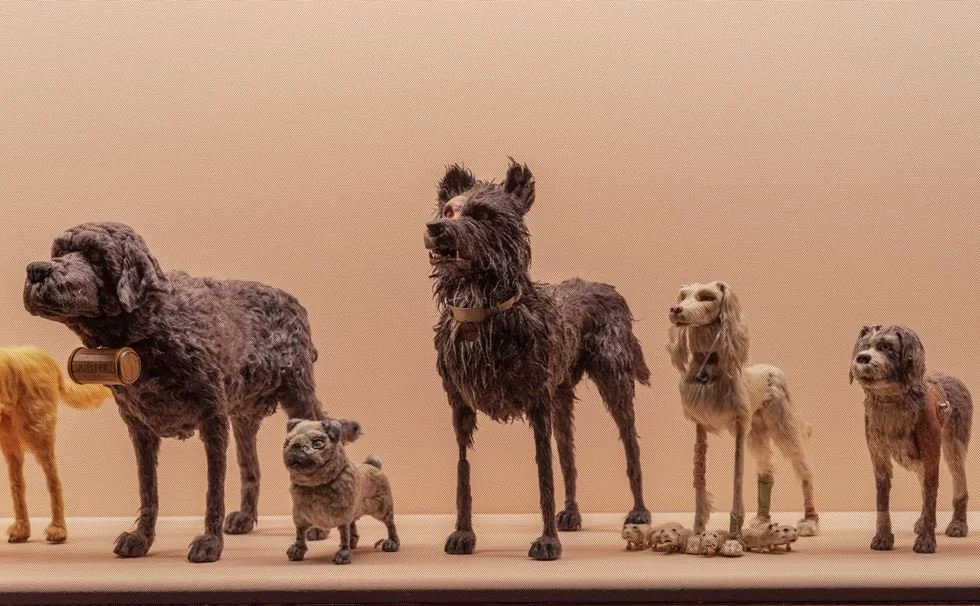
Stop motion woofers
Visitors will be able to get close to collections of polaroid photographs, costumes worn by beloved characters and - possibly the biggest draw of the exhibition - the stop-motion puppets that brought Fantastic Mr Fox and Isle of Dogs to life through such a meticulous and nostalgic medium. Paintings, miniatures, handwritten notes and more sit side by side with deep dives into films such as 1996’s directorial debut Bottle Rocket and 2023’s Oscar-winning short The Wonderful Story of Henry Sugar (Anderson’s clear obsession with Roald Dahl should surely lead him to adapt Dahl’s darker, weirder and more disturbing works - I’d pay good money to see a big screen version of My Uncle Oswald), and it’s hard not to be moved by such a singular commitment to a style that’s dominated aspects of popular culture in recent decades.
It was fun to be reminded of details I’d forgotten - the FENDI fur coat worn by Gwyneth Paltrow in The Royal Tenenbaums and the ‘Boy with Apple’ Renaissance portrait (that acted as a plot point in The Grand Budapest Hotel) are welcome additions that diehard fans will surely adore. After all, even critics of Wes Anderson movies would admit that they are all about the details and the visuals - and what details and visuals they are.
Once again, the Design Museum has captured the essence of an artist, transmuting a maximalist collection into something that allows for pondering, invites scrutiny and lends perspective. Even those - like me - who don’t buy wholesale into Anderson’s vision will find plenty to love here.
