
The Raj Palace Hotel Review: A Five-Star Archive of Jaipur’s Wonders
Among Jaipur's most prestigious heritage hotels, The Raj Palace delivers royal suites, museum-worthy interiors and a unique opportunity to experience Rajasthan's regal past in luxurious surroundings.
There are cities that overwhelm you the moment you arrive, and then there are cities that continue to overwhelm you long after you’ve left. Jaipur is very much the latter.
Indeed, Jaipur itself doesn’t need much introduction. The jewel in the crown of Rajasthan’s already-regal and utterly distinctive North Indian culture, Jaipur is not a place that deals in understatement. Loud with colour, dense with traffic and perpetually negotiating between its past and its present, it’s a city where palaces and architectural wonders press up against zig-zagging auto-rickshaws, centuries-old monuments share space with buzzing neon signage, and heat shimmers off roads that never seem to slow down.
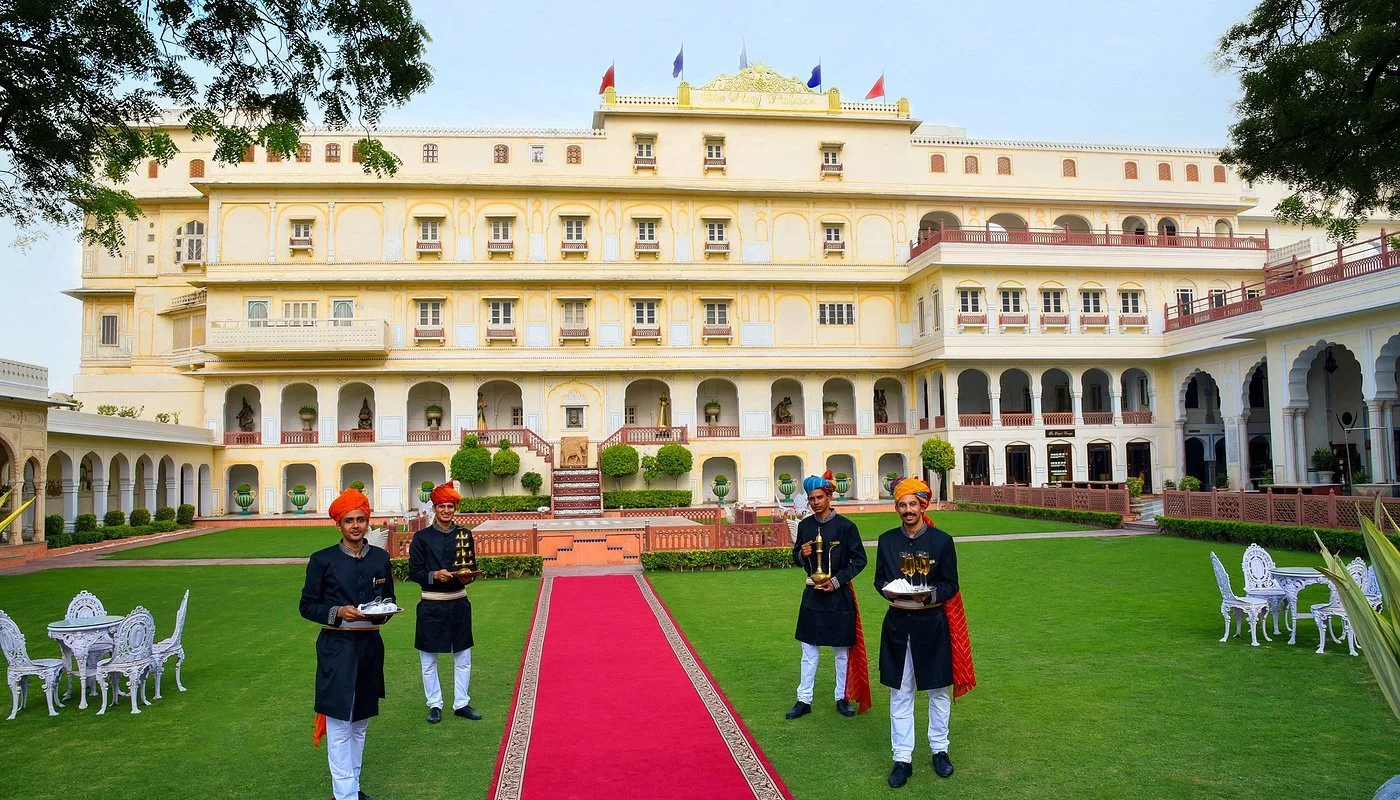
A regal palace welcome
Somehow, within the very heart of its relentless pace and dynamism, there exists an oasis of calm and sophistication: The Raj Palace, one of the Small Luxury Hotels of the World’s most iconic properties. It’s more than just that, however. It’s a place where time stands still, where noise fades into the distance and where chaos dissipates the moment one steps through the door.
The Raj Palace Jaipur doesn’t feel like a hotel so much as a pause in the city’s ongoing monologue. It’s a deliberate exhale, hidden behind fortified walls that have been standing, in one form or another, for centuries. Built originally as a royal residence and later transformed into what is now often described as one of India’s first “museum hotels”, it carries its history not as decoration but as structure. While a guest within these hallowed halls, you don’t merely learn about its past; you move through and immerse yourself in it, and the impact it makes simply cannot be overstated.
First Impressions of The Raj Palace Jaipur: A Regal Arrival
The entrance to the palace is deceptive. Jaipur’s chaos still exists just beyond the gates, but upon turning the sharp corner into the sizeable courtyard to the front of the property, the roar of engines and incessant beeping of horns is immediately muted. It’s as if someone has lowered the city’s volume without warning you first, and you’re lulled into a semblance of calm that’s almost other-worldly. Seriously – it’s like stepping back in time to an era before the advent of the internal combustion engine, and all you can hear is the rippling of water as it falls over ornamental fountains.
Once within the property, the pace shifts once again. I was welcomed with a traditional garland of marigolds and a cooling, floral and gentle-spiced drink, and once the various bits of bureaucracy were handled, my butler walked with me through shaded courtyards imbued with the kind of stillness that feels curated rather than accidental.
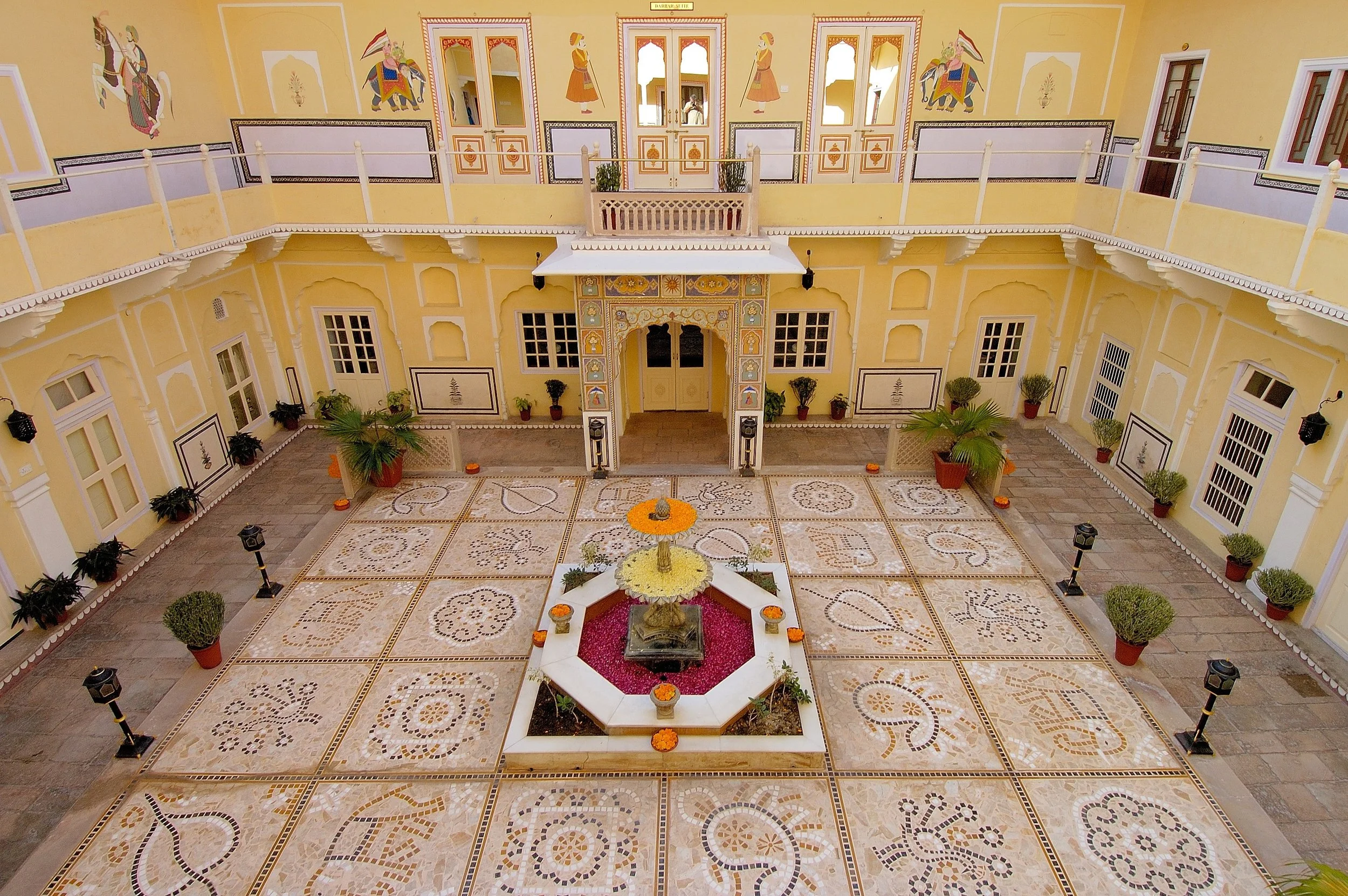
An encounter with a golden age
Once again, there is a brief sense that you’ve stepped into a different register of time, and it’s a sensation the team behind the hotel have worked hard to conjure in all-encompassing fashion. The Raj Palace is often described as a restored 18th-century mansion, once associated with Jaipur’s royal lineage. That lineage is not just visible in the architecture but embedded in how space is used; rooms open into corridors that open into courtyards that open into yet more rooms, as though privacy here was never meant to be singular, but rather layered to reveal a sense of the spectacular.
Further historical provenance comes in the form of the countless museum-like displays that line the walls; on the walk past the hotel’s restaurant, there’s a display of ancestral silks. The opposite wall features a cabinet filled with arrows and other Rajasthani weaponry, and there’s a sense that should the monsoon roll into town tomorrow, there’d be more than enough on show to keep curious guests engaged for weeks, if not months, at a time.
Indeed, the property unapologetically leans into its identity as a living archive; it’s the very definition of a heritage hotel; where artefacts are not confined to display cases but integrated into the rhythm of the building itself. Paintings, ceremonial objects, royal furnishings, and collections trace the aesthetic language of Rajasthan’s former courts, providing a sense of luxury that’s bolstered by undeniable authenticity.
The Hotel Suites: Opulence and Elegance Turned up to Eleven
The Raj Palace features no less than seventy opulent suites, each unique, each designed to further encapsulate that sense of heritage and wonder the hotel has built its powerful reputation upon.
My suite – one of the several heritage rooms in the hotel – wasn’t just a spacious, airy and beautifully positioned space in which to spend time, it was yet another example of how the property immerses guests in a sense of living history. A king-sized bed sat in the centre of the main room, surrounded by silver-clad furnishings. A nook by the window boasted an antique writing desk, and the bathroom included a sunken bath and enough soaps, lotions and unguents to delight even the most demanding of Maharajas and Ranis.
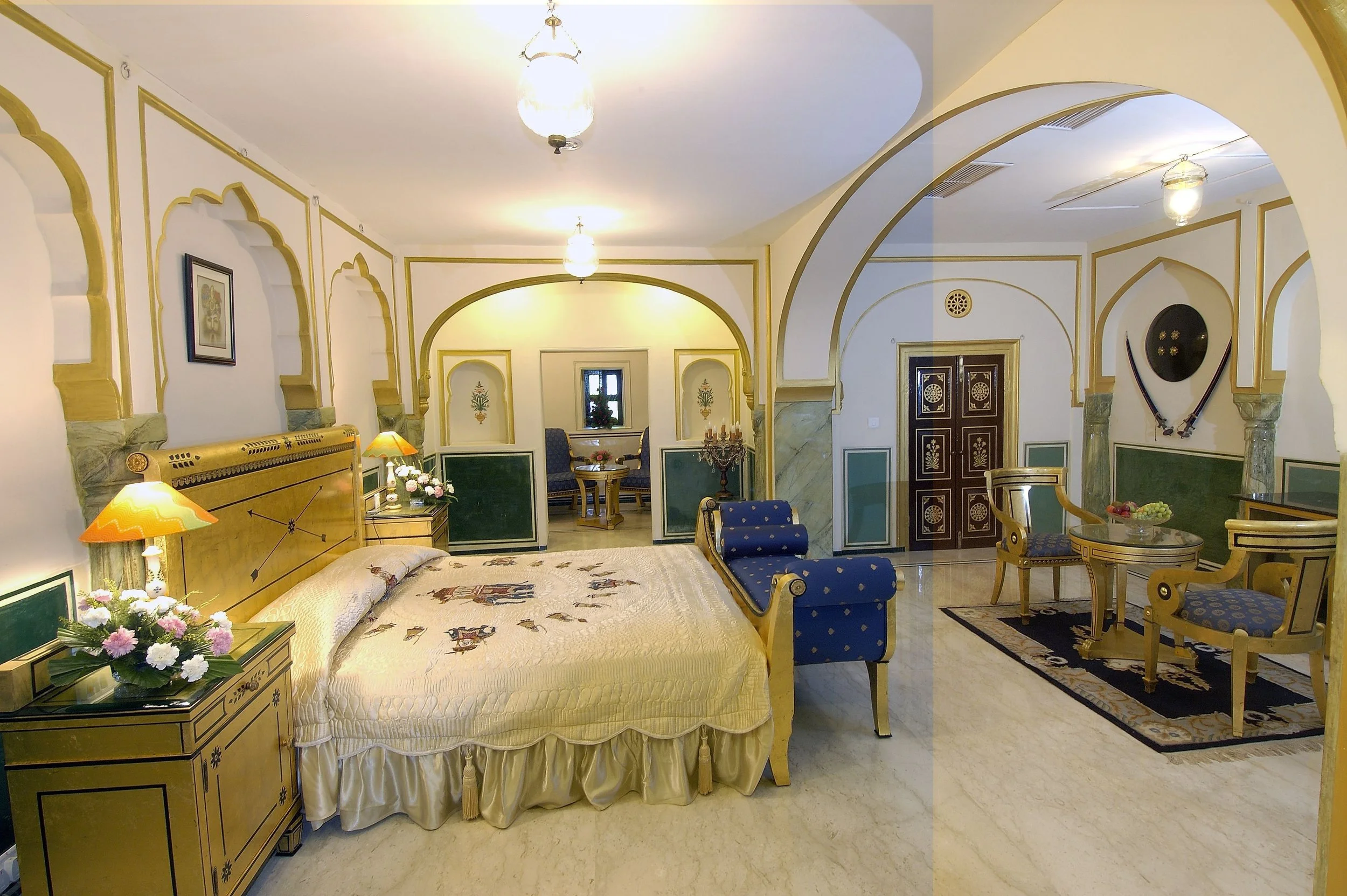
Inside the spectacular heritage suite
Thrillingly, there was a museum exhibit within the room, too – a large, curated display behind glass of silkwares worn by the royal inhabitants of the property in the 19th century, along with a selection of jewellery and other items. I’ve never come across such a feature in a hotel suite before, and it’s a remarkable inclusion that further deepened the sense that this is not a hotel attempting to simulate history, but rather a slice of history functioning as a hotel. The Raj Palace is simply continuing to do in 2026 what it’s always done brilliantly: host guests seeking to explore the riches of Jaipur, and showcase regal Rajasthani hospitality at its very best.
Dining at The Raj Palace Jaipur: Where Service and Ceremony Meet
The most vivid moment of the stay came, as it always should at dinner. Frankly, it is slightly difficult to describe the meal I was served without it sounding like theatre. That’s probably because it gleefully leaned into the theatrical, and I was more than happy to be along for the ride.
The Raj Palace has an extensive menu of Rajasthani, Indian and international dishes, prepared by a small but committed kitchen team that clearly knows its way around a tandoor oven. However, it would be nothing but churlish to not order the hotel’s signature dish: the silver plate thali, which acts as a showcase not only of the chef’s talents, but of the hotel’s commitment to serving up the spectacular.
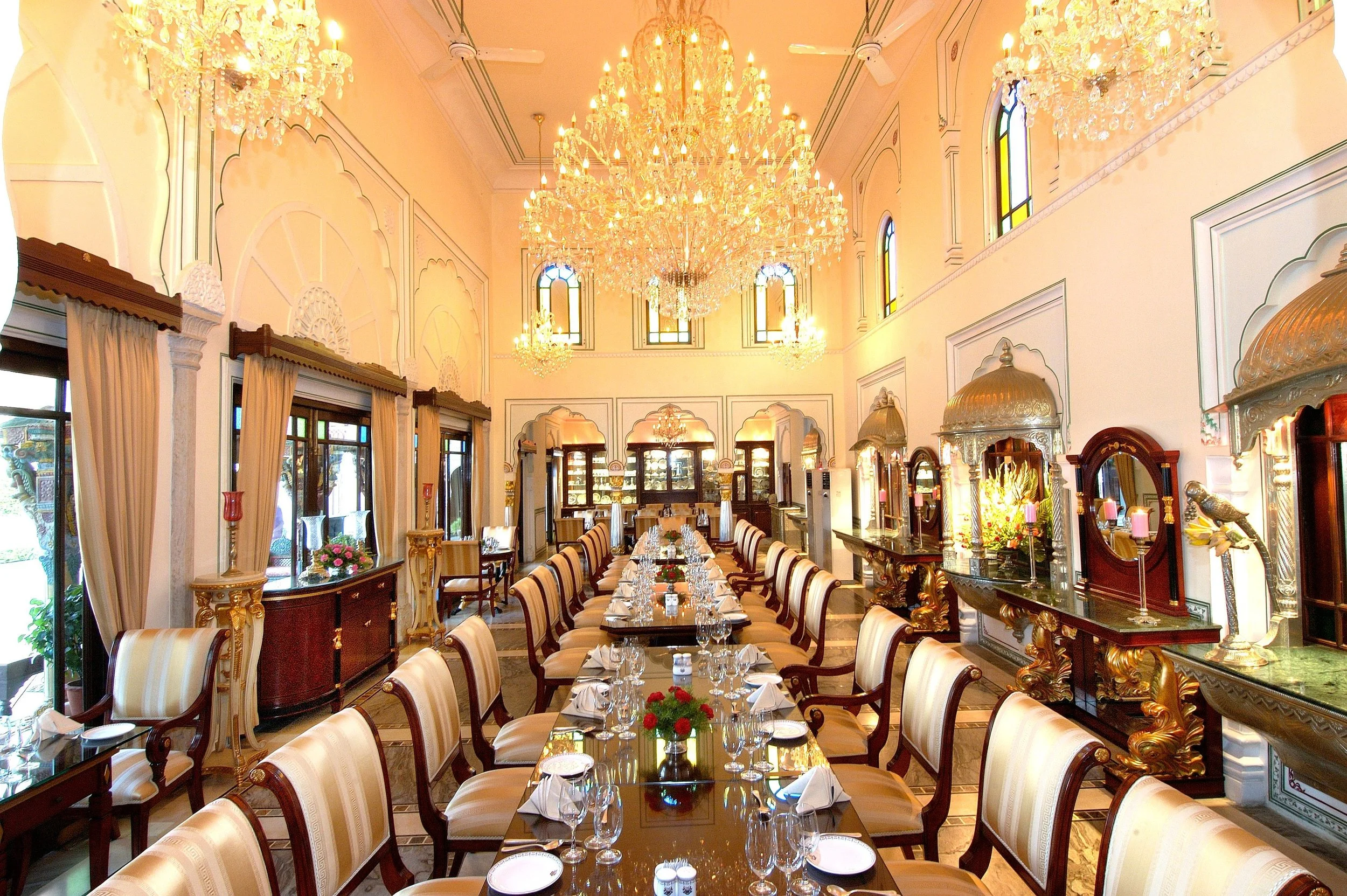
A suitably theatrical setting for dinner
Moments before dinner was served, a costumed herald marched into the dining space and stood to attention beside my table. He unfurled a scroll and formally announced the arrival of the meal in Persian (the lingua franca of the Mughal royal court who once occupied these hallowed halls), elongating the vowels in a truly impressive fashion. Beneath the gargantuan chandeliers and against the backdrop of a balmy Jaipur evening, the effect was deeply impressive.
The Thali itself was, frankly, worthy of such an introduction. A large silver platter featuring nine individual dishes – delicately charred paneer tikka, beetroot kofta, a buttery dish of dal makhani, spiced potatoes, okra curry and a selection of breads, amongst other treats – were a delight to the senses. I paired the meal with my first ever Indian wine (an impressively crisp Sauvignon Blanc), proving that the murmurings I’d heard over the past few years of a burgeoning subcontinental wine scene weren’t unfounded.
This was the unmistakable visual and multi-sensory language of royal Rajasthani dining, where food is structured not just by taste but by tradition. Historically, thalis in royal households were more than meals; they were curated presentations of hospitality, balancing flavour, health and hierarchy. It was delicious, obviously. Who doesn’t love a curry, not least one that comes with a slice of historical reenactment?
Jaipur Outside, Jaipur Inside
What makes The Raj Palace compelling is not just what it preserves, but what it filters out.
Outside its walls, Jaipur remains restless; a city of honking traffic, dense markets and constant movement between eras. Inside, everything is softened, slowed, almost insulated from that momentum. There are manicured lawns to traverse, croquet games to be played, a pool to luxuriate beside while sipping a freshly-brewed masala chai.
However, the hotel never fully detaches from the city, and nor should it – it’s a reminder of Jaipur’s unique identity in India’s much-lauded golden triangle, where history infuses the present in truly majestic fashion. It feels more like a counterbalance than an escape, and perhaps that is the Raj Palace’s real role: not to remove you from Jaipur, but to offer a different version of how Jaipur can be enjoyed, where stillness is possible, and where grandeur is part of the structure and experience.
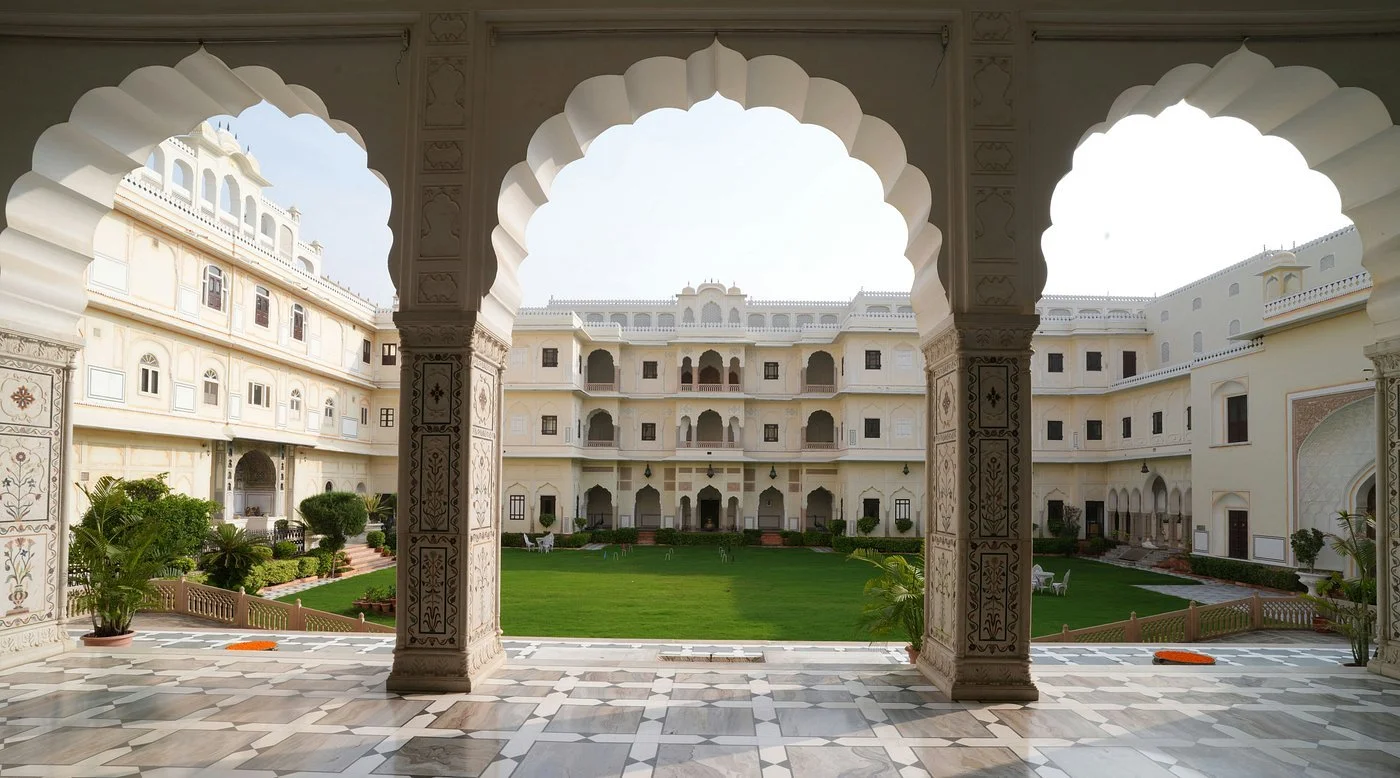
An unforgettable encounter with Rajasthani luxury
After all, The Raj Palace does not modernise its past into minimal luxury. It does not dilute its identity for ease of consumption. Instead, it holds onto its contradictions: it’s part museum, part residence, part stage set, part archive. It trusts guests to find their own way through it, and provides an elegant foundation from which to explore a fascinating corner of a deeply compelling part of the world. It’s carefully, stubbornly and beautifully preserved, and I wouldn’t have it any other way.
Book your stay at The Raj Palace here
