
David Hockney: A Year in Normandie at Serpentine Galleries Review
It’s a neat bit of timing. An exhibition about the passing of time, opening just as London edges into spring – well, it feels like my idea of a great afternoon out.
You can never truly subtract great art from the context in which it exists; that’s half the fun of it, after all. With the light stretching a little further into the evening, the parks begin to feel inhabited again as the trees do their yearly trick of being born anew. It’s exactly the kind of shift and transformation that David Hockney has always been alert to, as the UK’s greatest living documentor of the brilliance in the everyday, and the fantasy that inhabits the almost imperceptible changes in mood that most people register, albeit without necessarily truly noticing.
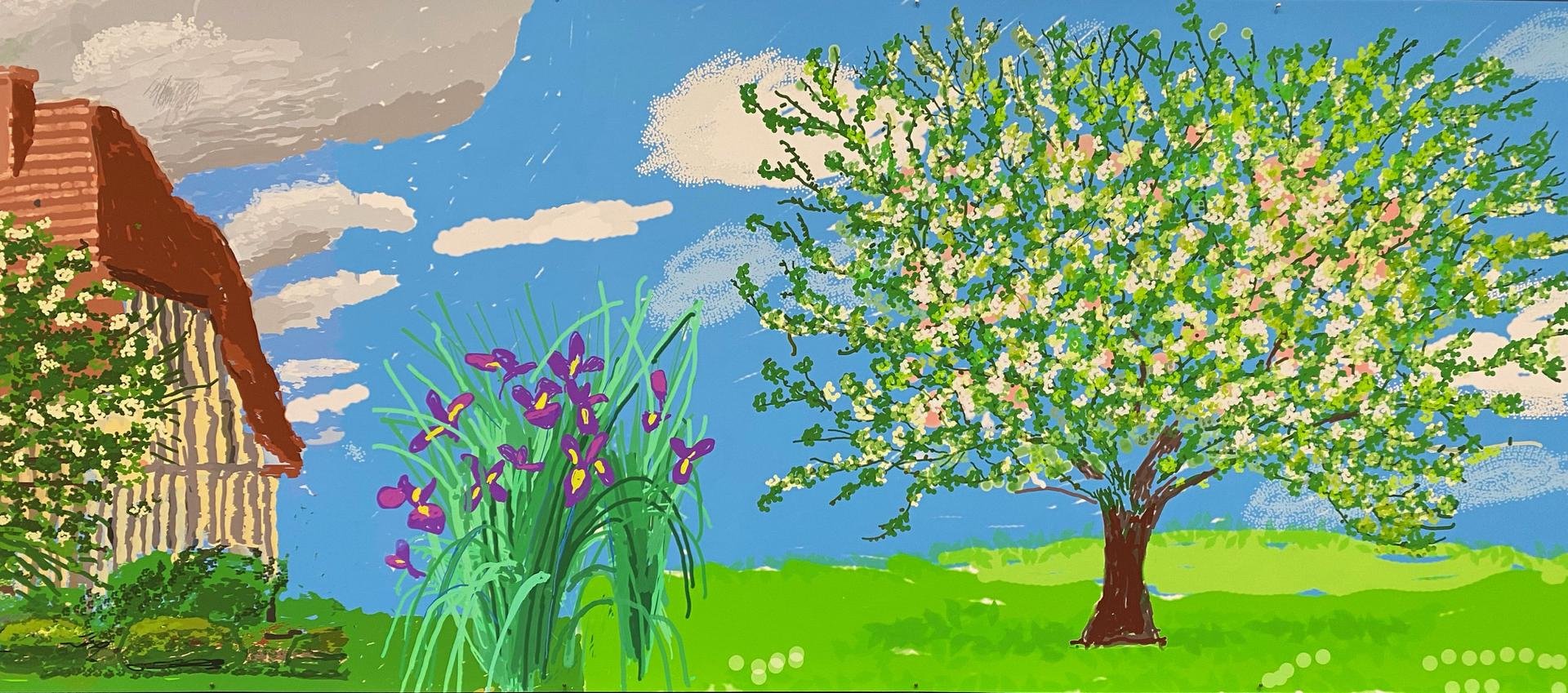
A Year in Normandie, detail
Following last year’s vast retrospective at the Fondation Louis Vuitton (more than 400 works spanning seven decades, and a true showcase of the man’s peerless career and place in the contemporary psyche) this show at the Serpentine North Gallery feels deliberately narrower in scope. A Year in Normandie and Some Other Thoughts about Painting isn’t trying to summarise a career, anyway. It’s more interested in where Hockney is now, and what continues to hold his attention.
At 88, that turns out, rather joyously, to be the same things it’s always been. Light, time, repetition, the slow drift of seasons and moments in which bodies can be and landscapes can be celebrated for their innate abstraction.
It’s not an exhibition that shies from the spectacular, however. The main gallery is wrapped in A Year in Normandie, a panoramic frieze made up of more than 100 iPad paintings created during lockdown in 2020. It traces the view from his former studio in northern France, not as a sequence of events but as a continuous unfolding. Trees fill out, then thin. Greens intensify then recede into Larkin’s blueish middle-distance. Winter arrives without ceremony and leaves in much the same way, and round and round we go.
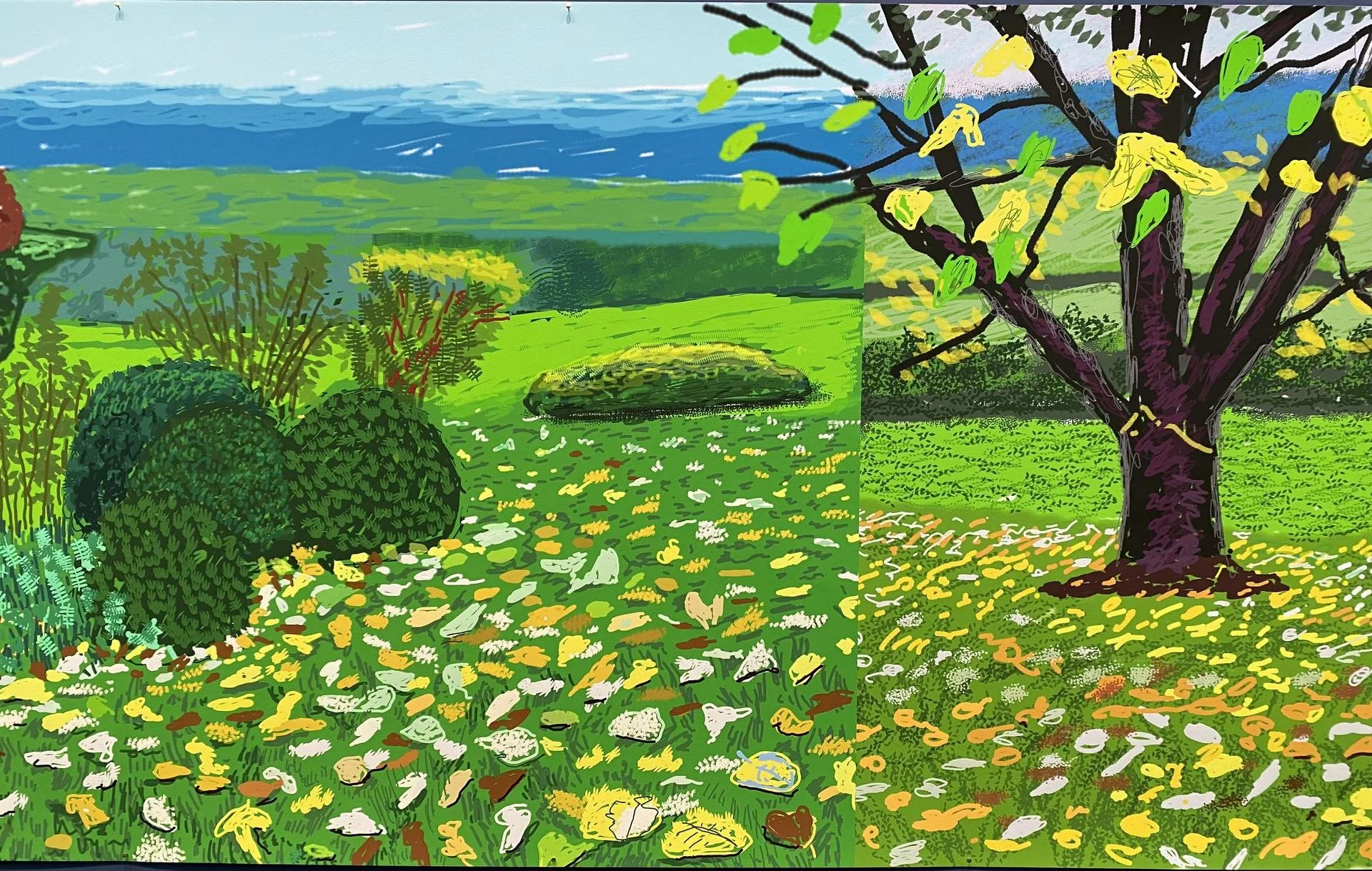
iPad art goes pop
The references are there if you want them, and it’s tempting to apply the historical majesty of the Bayeux Tapestry and Chinese scroll painting. However, that temptation should probably be kept at bay, as one suspects they never weighed particularly heavily on Hockney’s mind and so probably shouldn’t sit on ours. What stands out more is how comfortably digital this all feels, and how well that works in Hockney’s palette and way of seeing the world from his window. The flat planes of colour, the clarity of line and the slightly heightened saturation can’t help but produce echoes of his California work, but they’re translated into something quieter and more cyclical. There’s drama here, for sure, but it isn’t in any single image but rather in the accumulation of them.
Smaller rooms reveal the newer work made specifically for this exhibition in late 2025. Ten paintings in total (five portraits, five still lifes) all share a similar structure that’s recognisably Hockneyan; there’s plenty of straight-on perspective, and subjects are positioned against a checkered tablecloth that tilts gently towards the viewer. It’s as if the whole scene has been set up with just enough intention to hold everything in place; a popification of everyday life.
The portraits are where things loosen slightly, and Hockney gives us a privileged look into something resembling his real life. Friends, family and other people who clearly sit comfortably in the artist’s orbit (including his partner Jean-Pierre Gonçalves de Lima, his great-nephew Richard Hockney and the collector Joe Hage) are present and shown with tangible wit and affection. Indeed, there’s a lightness to the way they’re handled, and the viewer is invited to pore over small details that feel observed in passing rather than meticulously constructed. Jack Ransome, who designed Hockney’s glasses, looks faintly amused by the whole process. Thomas Mupfupi, one of his carers, wears a badge reading ‘END BOSSINESS SOON’ – which, quite frankly, tells you more about their dynamic than anything else could.
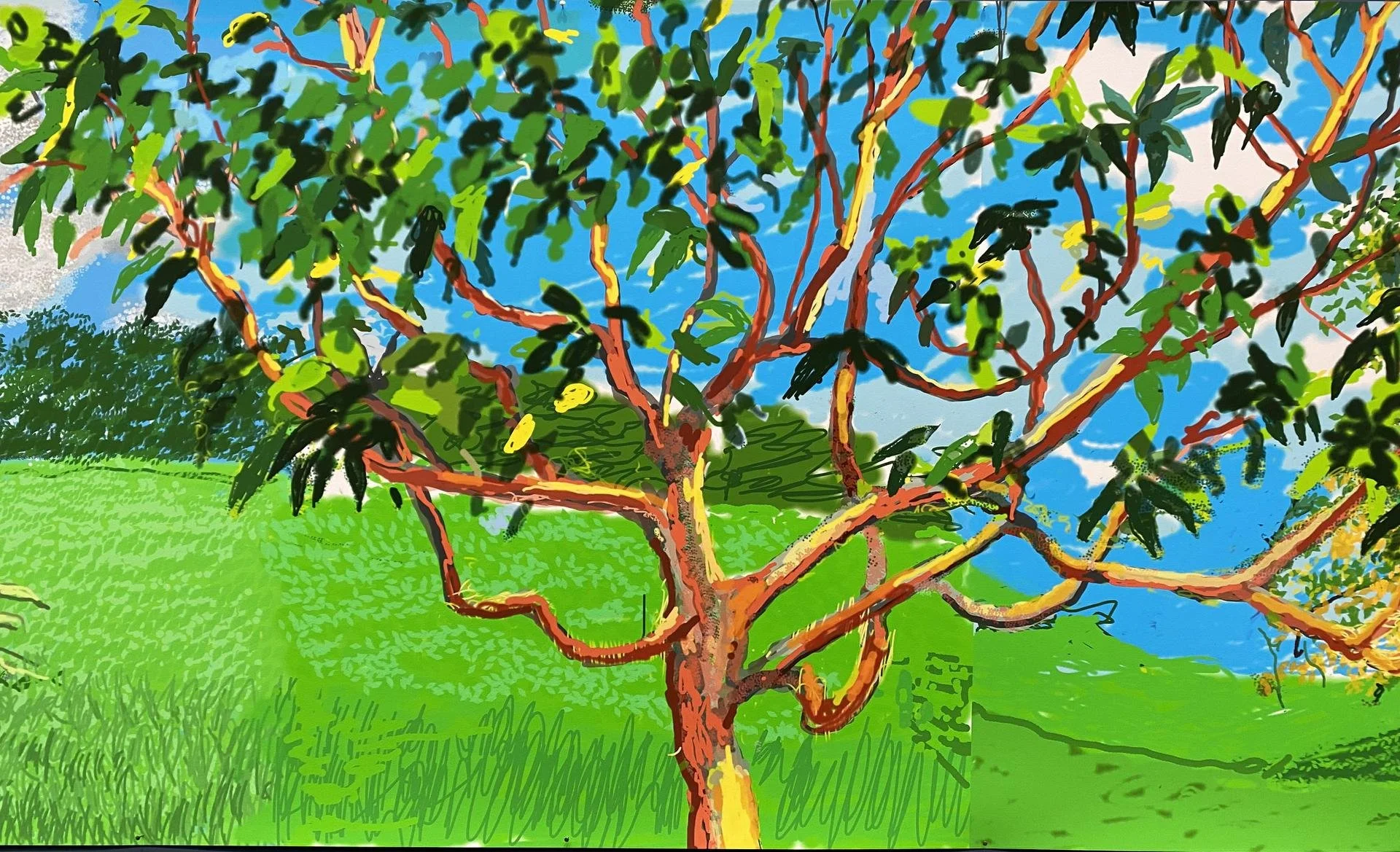
The perfect spring exhibition at The Serpentine Galleries
The still lifes circle back to more familiar territory. Hockney has long played with the idea that all figurative painting is, at its core, abstract – a concept that now feels almost quaint. His worldview is that once something is translated onto a flat surface, it’s already a step removed from reality. Here, that idea is pushed a little further. Objects sit within compositions that feel both precise and slightly unstable, as if they could tip into pure abstraction if you looked at them for long enough; something I’d urge you to do during your time in this exhibition.
So, what ties it all together? Hockney remains open-armed in his approach to how he wants his audience to see his work, and as such, there isn’t so much a theme as a way of looking. There’s no attempt to direct you towards a single conclusion, no obvious hierarchy of importance. Instead, the exhibition keeps returning to the same quiet proposition: paying attention, properly paying attention, is enough and everything else follows from that.
Or doesn’t.
Plan your trip to David Hockney: A Year in Normandie and Other Some Thoughts About Painting here.
