
Blitz: The Club That Shaped the 80s at the Design Museum Review
If there’s an equivalent to Covent Garden’s iconic, genre-defining Blitz Club today, I’ve never heard of it and am certainly far from cool enough – or, let’s face it, young enough – to be in its orbit. However, you don’t have to look far across the homogenous, cookie-cutter dullscape that is contemporary popular youth culture to get the feeling that there’s simply nothing out there remotely similar, and nor perhaps will there ever be.
In fact, in the post-post-modern glass cage of pop culture, where everything has referenced itself to the point of utter irrelevance and to ever-diminishing returns, we desperately need a reminder of what imaginative, colourful and bright young things can – and arguably must – create. There’s a strong case to be made that London’s Design Museum (or indeed, any museum) isn’t the ideal place for such a reminder, but there’s an equally strong case that it’s a hell of a lot better than nothing.
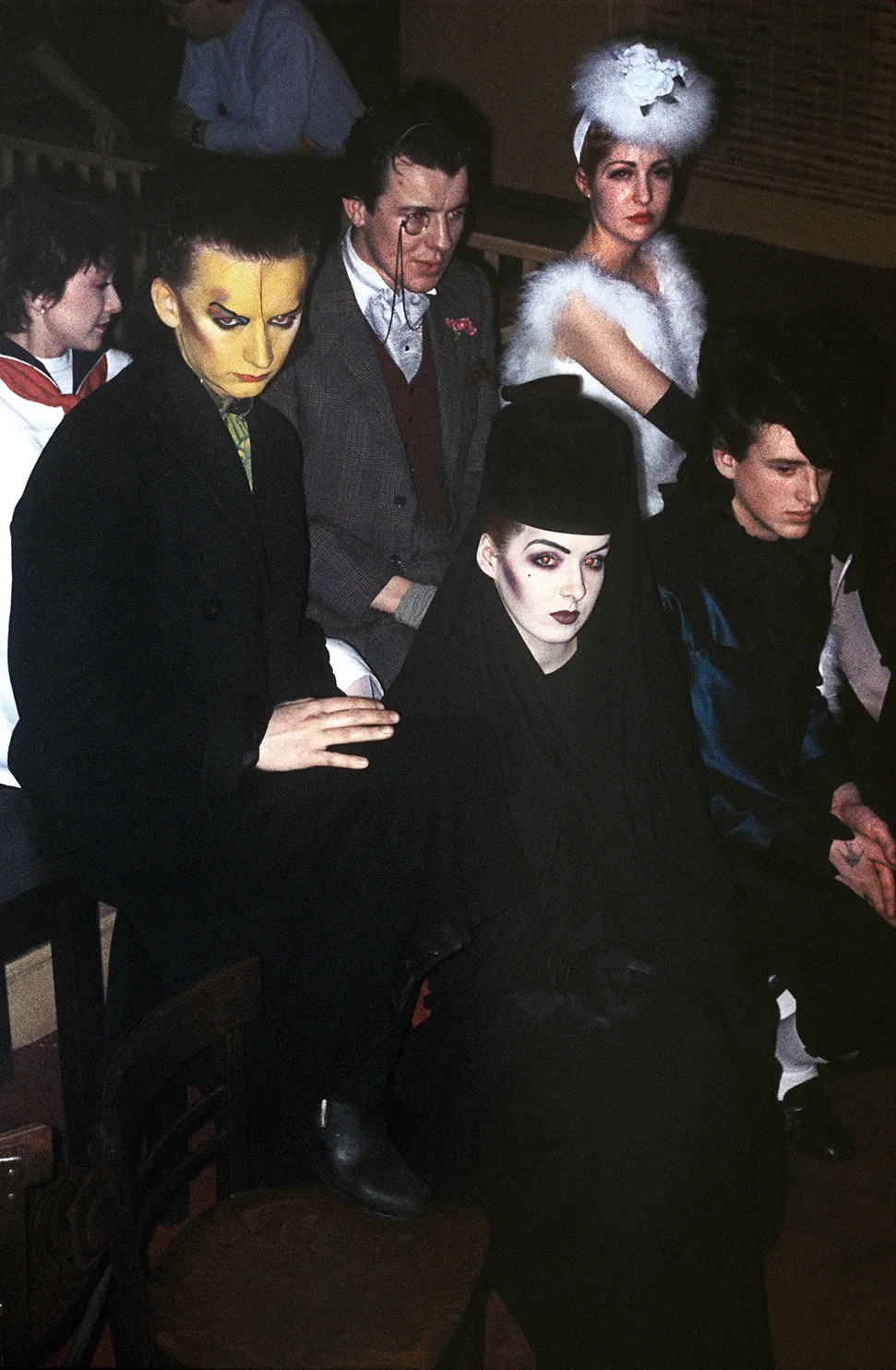
Vivienne Lynn, Boy George, Chris Sullivan, Kim Bowen, Theresa Thurmer and friend, 1980. © Derek Ridgers c/o Unravel Productions
The Blitz exhibition at the Design Museum is a testament to the mighty influence of this particular club and its iridescent denizens and frequenters. It was, after all, a hub that formed the enduring image of the 1980s; a hotbed of ferocious individualism and relentless experimentation, and one of those hallowed cauldrons of inspiration that gave rise to a staggering number of artists, designers and other creatives, many of whom went on to become household names and national treasures (whether they embrace that label or not). It’s barely possible for any museum exhibition to really do justice to such a cultural phenomenon, but “Blitz: The Club That Shaped the 80s”, to give the full title, does a sterling job of showcasing many of its highlights and a handful of worthy hidden gems.
The exhibition assumes that visitors already know the story behind the club, which was hosted by Steve Strange (New Romantic progenitor and singer of the band Visage) and Rusty Egan (fashion maven and drummer of The Rich Kids, which featured fellow New Wave icon Midge Ure and Sex Pistol Glen Matlock) in a shockingly tiny wine bar on Great Queen Street. With a capacity of just 50 and running for a mere two years between 1979 and 1981, the Blitz turned Tuesday evenings in Central London into a stark riot of makeup, frills and maximalist silk and taffeta, where bold young changemakers exuded a look and sound that was inspired by a heady blend of German Expressionist cinema, Weimar-era Cabaret and whatever Bowie was doing that year.
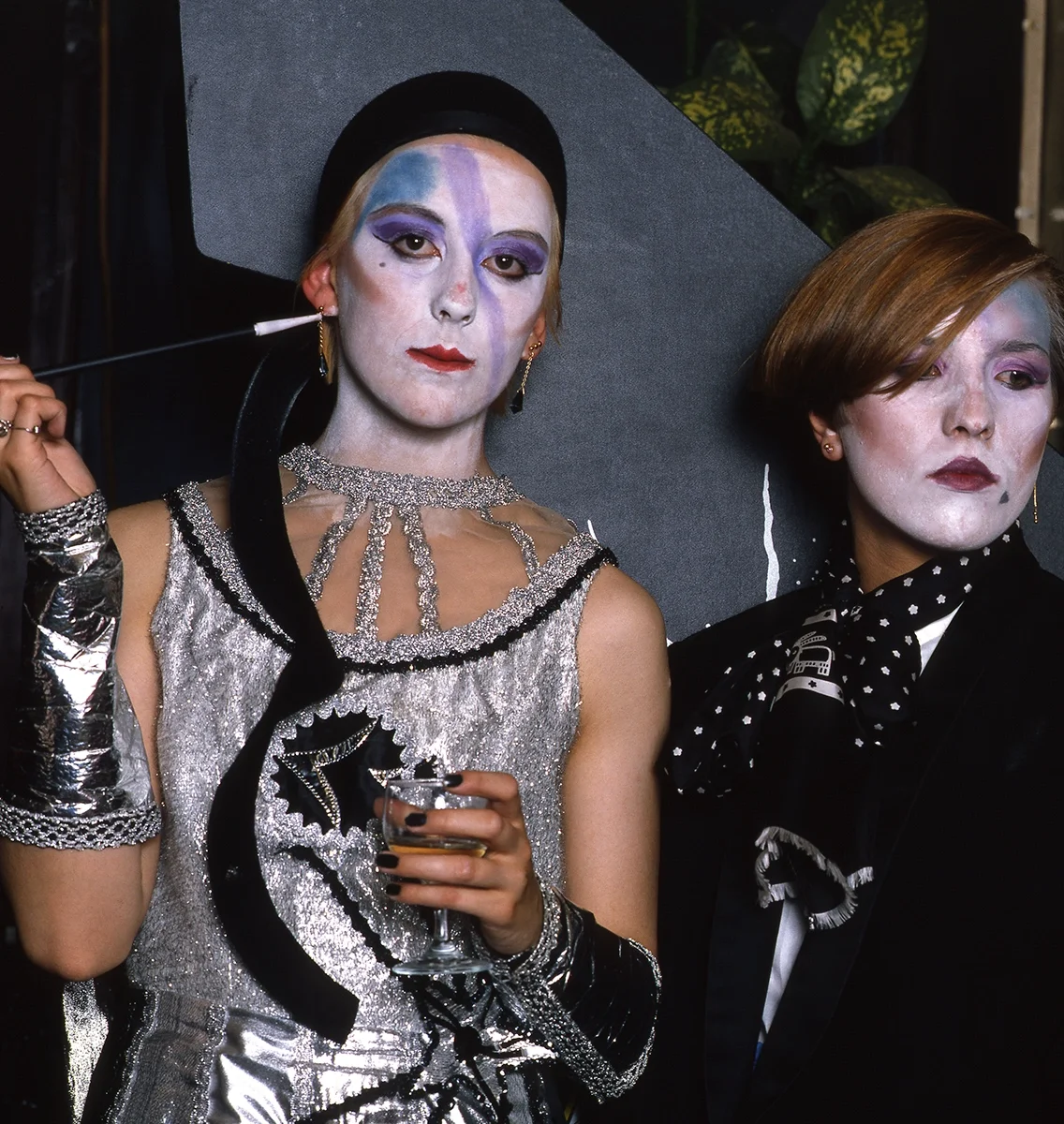
Blitz Kids, 1980. Robyn Beeche Foundation
The Blitz Kids (as the regulars were known before they embraced the label that stuck: The New Romantics) were among the last truly great and transformational London subcultures. They were a reimagined, day-glo and occasionally sinister reimagining of the Bright Young Things, caught between the nose-diving of punk and the rise of Thatcherism in all its drab majesty and hollowness. Strange and Egan were on a warpath of their own creation, pushing new frontiers of taste, sound and fashion, and refusing entry to anyone without the most outre taste in music or the most outrageous outfits. Legend has it that Mick Jagger was turned away at the door by Steve Strange himself. It was supposedly because he turned up in jeans, but it’s just as likely due to Sir Mick representing a decade, look, sound and attitude that was actively being put to rest.
The Blitz wasn’t just about style over substance – the style was the substance, the two were irretrievably intertwined. If Strange and Egan couldn’t find the futuristic song they needed to match their cyber-vaudevillain outfits that week, they’d get behind their synthesizers and make it themselves. If they needed a cyber-vaudevillain outfit to go with their latest song… well, one of the Blitz kids was there to source and stitch it for them. That was the essence: it was a hub of contacts, of ambitions, of talents and shared visions.
The Design Museum does a great job of highlighting some of the most luminous names to cut their teeth at The Blitz. Boy George (who worked in the cloakroom and studiously took notes on which a decade-spanning career was built) is perhaps the most recognisable, but there’s also the boys who became Spandau Ballet, Midge Ure, Marilyn, Perry Haines (founder of i-D magazine) and dozens more fashion designers, DJs, musicians and imagineers of 80s culture and beyond. Several of those names helped curate the exhibition, offering immersive interviews and assisting in the creation of the displays and items on show. All in all, it’s a successful encapsulation of the nightspot, its eclectic attitude and the impact it had on an unmistakable era of creative force.
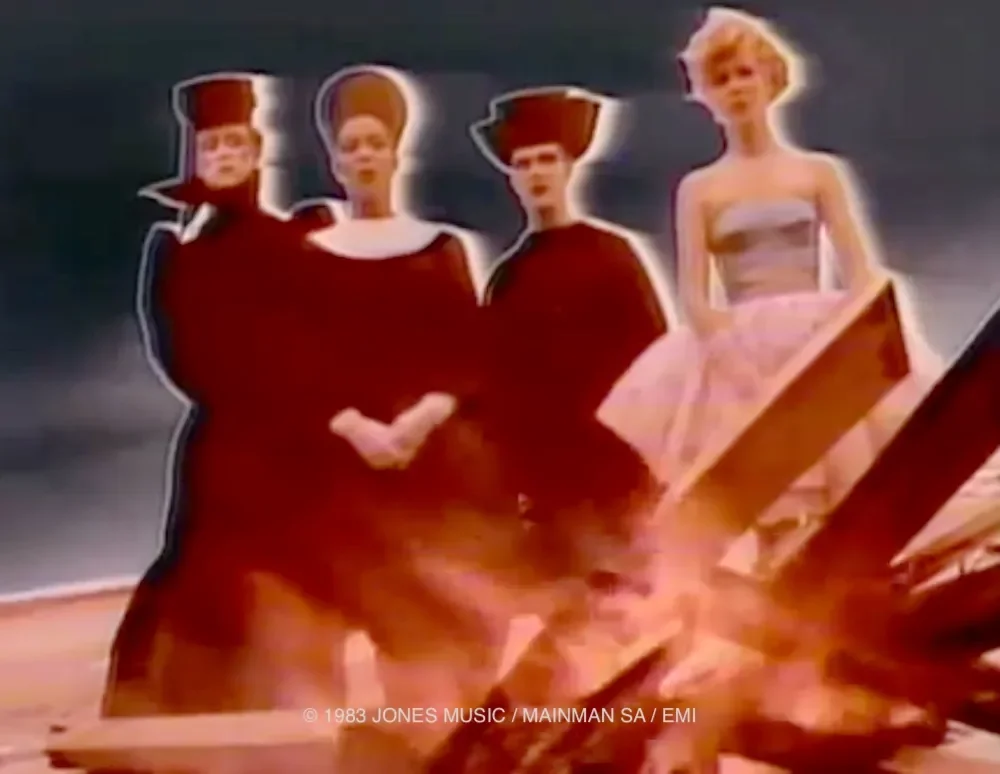
Blitz Kids in Bowies’ Ashes to Ashes music video
Fans and the curious will be delighted by the personal items showcased by the exhibition. There’s about 250 bits and bobs to uncover – a veritable treasure trove of New Romantic relics and ikons, including complete items of furniture, accessories, outfits and fashion designs, photographs, vinyl records, musical instruments and works of art. There’s the original 70s synthesizer on which Spandau Ballet’s first album was written, a blue tartan suit by Chris Sullivan, costume designs by Sade and handwritten lyrics by Gary Kemp. It’s bricolage turned up to eleven, to borrow a rock ‘n’ roll cliche they’d surely despise… and it’s a whole lot of fun.
Of course, Bowie’s shadow looms large over the exhibition, as it arguably does over the Design Museum itself. Bowie was fascinated by The Blitz Kids, possibly because he recognised in them a continuation of something he ignited a decade earlier with the self-immolation of Ziggy Stardust, possibly because he correctly identified that by 1980, he was almost over the hill in pop star years. Instead of railing against them, Bowie invited members of the club to join him in a last hurrah for that particular era of his career – the album ‘Scary Monsters’ may have been the last great Bowie record until his swan song ‘Black Star’, and owed much to the Blitz Kids’ sound and vision. Indeed, Darla-Jane Gilroy, who gets plenty of time and attention at this exhibition, collaborated on the beloved music video for ‘Ashes to Ashes’, turning up in clerical robes and collar and offering a funeral march and odd, gestural movements that continue to hold the gaze today.
Forty-five years have passed, and nostalgia has done its trick of imbuing the past with a breathless, sweeping romance. However, as Blitz: The Club That Shaped the 80s shows, sometimes those rose-tinted spectacles and raised eyebrows are more than justified. The exhibition isn’t just a fantastic snapshot of a truly unique period in music and fashion, it’s a window into a time when such things both really, really mattered and were utterly ephemeral. The fact that there’s no equivalent today is cause for real concern and careful thought.
What will today’s Bright Young Things be looking back on in 45 years? Most likely very little, but I’d love to be proven wrong.
‘Blitz: the club that shaped the 80s’ runs until 29 March 2026 designmuseum.org
