
Dirty Looks: Desire and Decay in Fashion at the Barbican Review
Maybe it’s the undying teenage goth in me, but there’s always been an enduring and irresistible pull to the beauty of decay at the heart of my appreciation for art and fashion. Sounds dramatic? A little tasteless? That’s half the point. I spent much of my early 20s engrossed by late-19th century decadent literature and art - poring over novels and paintings that celebrated by Baudelaire referred to as deliquescence, or the beauty inherent in the grotesque, and that fascinating has never really left me.
After all, part of our collective cultural love and appreciation for Victorian high fashion is an attraction to the faded, the haunted, the sense that something has been left to ruin… and it’s a fascination that continues to inform popular culture and visual idioms, whether it’s the constant recycling of literary works like Wuthering Heights (poised for yet another bodice-ripping reimagining this year), the kooky deathrock aesthetic of Tim Burton’s interpretation of the Addams Family, or various catwalk shows’ perennial fixation with the gothic aesthetic.
Anyway, I digress. Dirty Looks: Desire and Decay in Fashion, currently hosted within the environs of The Barbican’s postmodern brutalist magnificence, isn’t an exhibition of gothic fashion in the literal sense, but it most definitely occupies the same dark corners of culture. The good news? It’s absolutely fantastic - a bonafide feast for the senses which shies not from thought-provoking themes and a striking, confrontational visual impact.
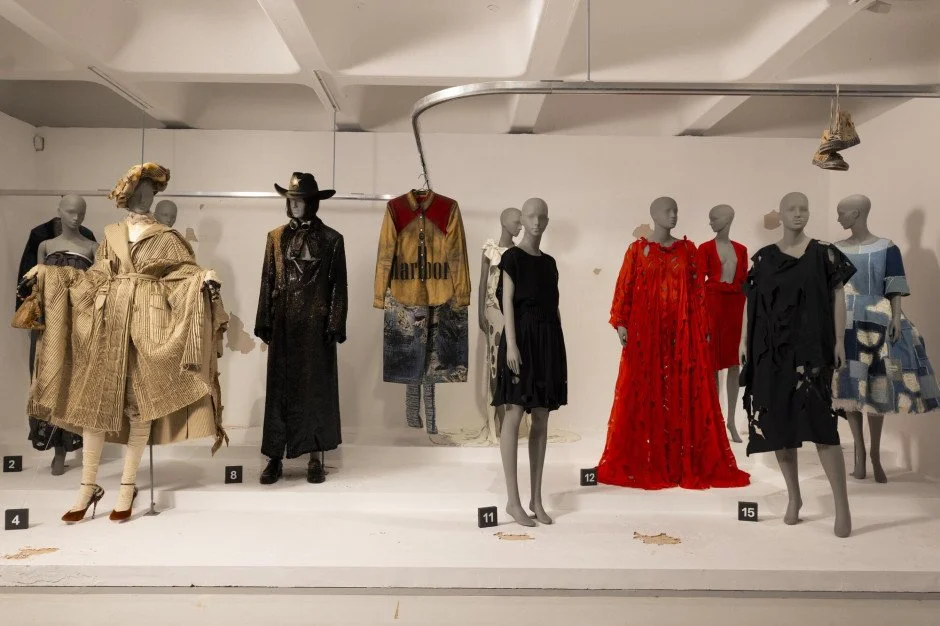
An array of grotesque delights
For lovers of the more artful, gallery-worthy side of high fashion, there’s plenty to adore among the impressive archive pulls on display; it’s rare to visit a fashion exhibition that’s well worth taking real time to explore. It’s not exactly a celebration of decay and filth, rather an acknowledgement of its place within society, and you absorb the grime and grit by a process of osmosis as you wander from exhibit to exhibit, uttering the occasional gasp of recognition at iconic pieces you may or may not have forgotten.
Highlights of the show include Di Petsa’s wedding dress from the 2021 Wet Brides collection, Robert Wun’s 2023 Wine Stain Gown (complete with Burton-esque blood red Swarovski crystal gloves) and the utterly grim-yet-brilliant After The Orgy - clothes that have been half-mummified in a peat bog and suspended in various discomforting forms. It embraces decay and dirt, death and sex; the full gamut of human and natural messiness is elevated to artfulness in a deliciously playful manner, dancing around the edges of some grandiose philosophical commentary that’s always out of reach, yet consistently just beneath the skin.
As with anything remotely gothic in London, the ghost of Charles Dickens is never far away. Indeed, perhaps the most famous dress in that entire literary oeuvre - the cobwebbed and threadbare wedding gown of the doomed Miss Haversham - is present and correct in pieces from Alexander McQueen’s controversial Highland Rape show from 1995. The idiom is displayed in more bizarre ways, too - Hussein Chalayan’s 1993 graduate collection, in which he buried and exhumed dresses in London’s plague-pit soils, is one to turn the heads of visitors. More contemporary vices are represented via Andrew Groves’ Cocaine Nights creations (most famously featuring the razor blade dress), and Issey Miyake reminds us of his glory days as a provocateur via the 1998 Dragon: Explosion collection.
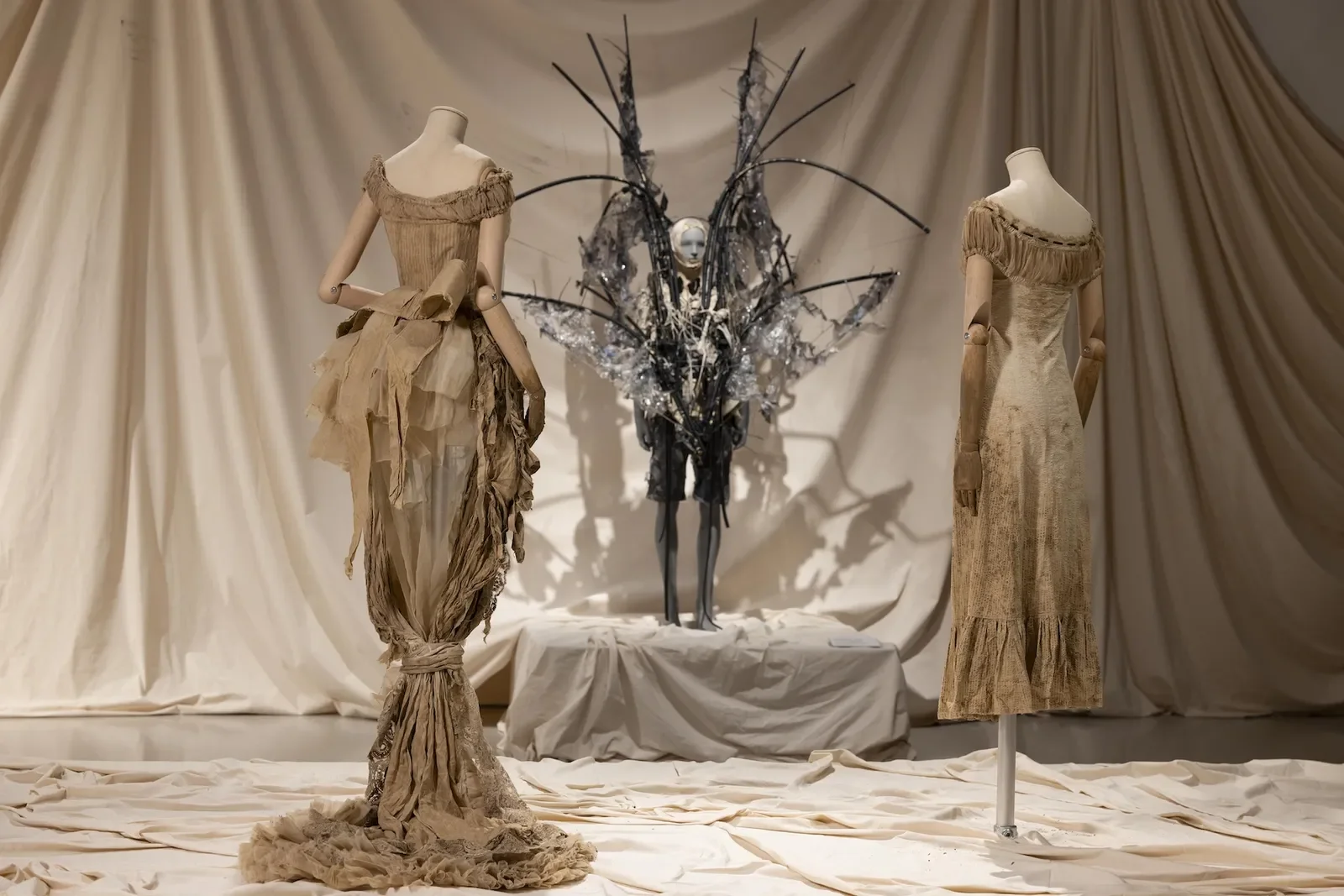
Filth and fury
As you wander through the exhibition, you feel yourself as a crooked archivist, a mudlark, a purefinder and a graverobber; everywhere there are yellowed sweat stains demonstrating the most fundamental human interactions with fabric. There are greasy marks left by fast food, clothes that have been drenched in god-knows-what, buried, burned and left to fester.
It’s a potent reminder that being unclean isn’t so much a taboo but an inevitability - it’s inherent to the passing of time, the exercising of various passions while still dressed, a natural state of being that we (understandably) hide and deny. In an age of strict beauty norms and the ‘clean girl’ aesthetic, it feels almost revolutionary. In an era of fast fashion and disposable garments, it’s a reminder that getting dirty is a byproduct of loving our clothes a little too much. Dirty Looks: Desire and Decay in Fashion skews the aspirational and hints at no shortage of profound messages, but ultimately - much like dancing to Bauhaus and The Sisters of Mercy in a murky, sweaty nightclub - it’s a whole lot of fun.
Dirty Looks: Desire and Decay in Fashion is running at The Barbican until January 2026.
