
Whistler at Tate Britain Review: The Must-See London Exhibition of 2026
You know Whistler, even if you think you don’t. He’s one of those small handful of fine artists whose most famous work has long since entered the public consciousness, meaning a full body of masterpieces have ultimately become slightly eclipsed in the process.

The one we all know too well, Whistler’s Mother
Indeed, for decades, the cultural memory of James McNeill Whistler has been unfairly reduced to a single, sombre gesture of Victorian piety. The portrait of his mother sitting in profile, draped in black and grey, is a genuinely exceptional painting, but it’s one that ended up calcifying the reputation of a man who was, quite possibly, the late nineteenth-century London’s most glittering, restless and delightfully disruptive aesthetic radical.
Whistler was most certainly not a one-hit-wonder of his day, and it’s high time this was put right.
Mercifully, Tate Britain has launched Europe’s largest Whistler retrospective in a generation, and to undeniably stunning effect. Step into the hallowed gallery off an overcast Pimlico street this summer, and you’ll uncover a sweeping, one hundred and fifty work exhibition that successfully rescues the artist from his own fame. The mission statement is abundantly clear: to reposition Whistler as the cosmopolitan dandy who pushed Western art to the absolute precipice of abstraction, exactly as you suspect he always intended.
Curating the Ego
I remember first coming across Whistler as a student, back when I was deeply immersed in the florid grot and glorious filth of the fin-de-siecle writers of Victorian London (seriously, if you want to uncover just how fabulously, psychedelically perverse those esteemed wordsmiths could get, I’d encourage you to seek out Aubrey Beardsley’s ‘Under The Hill’, and ponder on just what Venus was getting up to with her pet unicorn).
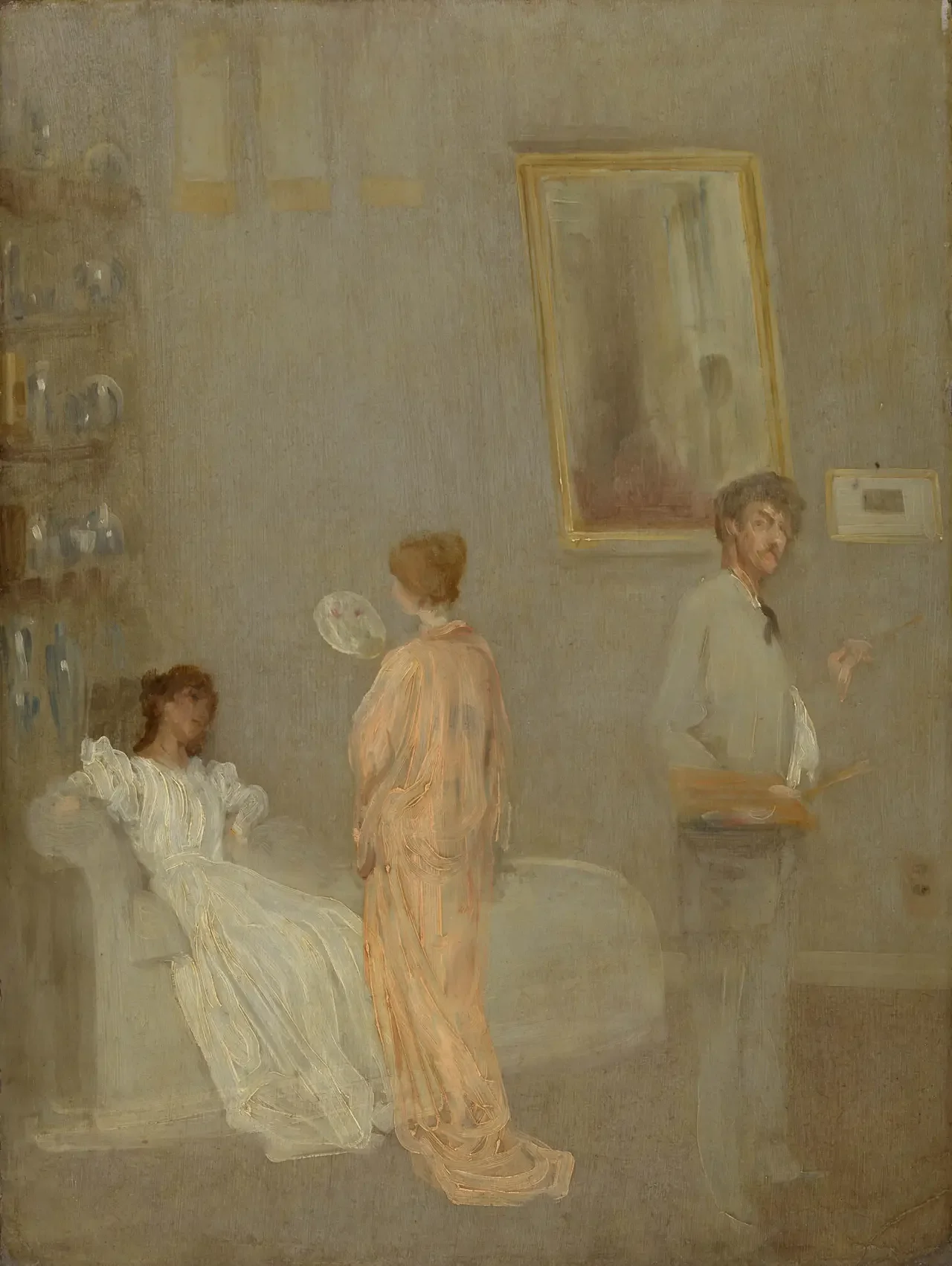
Symphony in White No.2
Whistler was adjacent to the perfumed bombast of Wilde, Baudelaire and all the rest, but offered a brilliant artistic idiom that captured both the inky darkness and gilded extravagance of the age. I remember wondering, even then, why so little of his work was as widely known as some of his contemporaries, making this exhibition at the Tate one I’ve looked forward to with bonafide fanboy excitement.
The good news? It’s a proper deep dive into the broad range of his output, successfully contextualising the artist across a significant range of works. The exhibition does what all retrospectives should ideally aim for: offer new insight to established enthusiasts and a profound introduction to those less familiar with what he did so well.
The curators have envisioned the retrospective as a tangible journey; rather than guiding visitors through a polite, linear biography, the show opens with a tribute to Whistler’s working studio. Here, four major self-portraits are brought together, including The Artist in His Studio from the mid-1860s, allowing us to see him not as a historical artifact to be revered, but as a living tastemaker surrounded by his curated obsessions. Exquisite East Asian ceramics, vibrant Japanese woodblock prints and custom, artist-designed furniture fill the space.
The result is rather significant and establishes a truth that any modern connoisseur will instantly recognise: Whistler did not merely paint, he meticulously constructed an environment where his lifestyle and his art dissolved into one another.
This isn’t just an embodiment of the 19th century decadent mantra of art for art’s sake, it’s art for the sake of the artist and the world they inhabit.
There’s a gorgeous introversion at play throughout the works on show – a gothic auteurship that produces something slightly suffocating and lonely, but all the more romantic for it. “Nature is very rarely right”, Whistler famously argued, believing that the true artist must invent their own harmony of colour and line. Looking at his self-portraiture and empty, foggy, bleak landscapes, one strongly suspects he felt the same way about other people.
Global Routes to Fog, Filth and Gold
Long before he was a fixture of the Chelsea bohemian scene, Whistler was a nomad. The exhibition unearths his teenage sketchbooks from his time at the Imperial Academy of Arts in St. Petersburg and his unlikely, brief stint at West Point Military Academy, where he was swiftly dismissed for a distinct lack of discipline (further securing his rock ‘n’ roll credentials long before such a concept had a concrete identity).
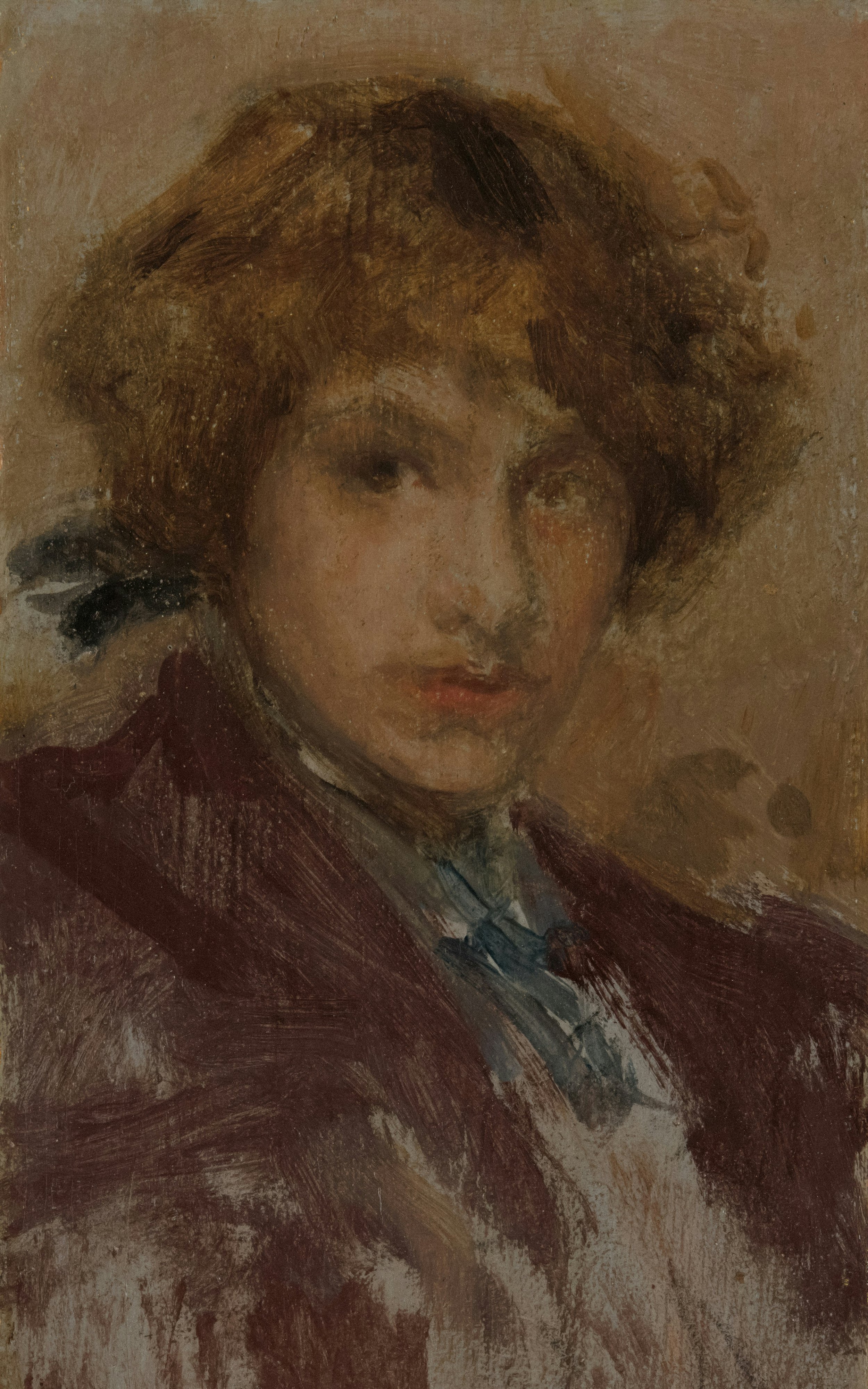
Portrait of a young girl
These early journals reveal the global foundations of his recognisable style; one which deftly borrowed from Spanish portraiture in absorbing the moody, aristocratic restraint of Velázquez, and Parisian Impressionism from working alongside Edgar Degas in the 1860s. Filtered through an eye focused on the gritty, poetic beauty of working-class spaces, he helped the art world stagger into a slightly bleaker but necessary future.
Despite the quality of work on show, the exhibition occasionally stumbles into the trap of its own scale. The inclusion of a photographic dive into Harmony in Blue and Gold (more famously known as The Peacock Room), feels a bit like looking at vacation slides of a house you were not invited to visit. Originally commissioned as a dining room for shipping magnate Frederick Richards Leyland at his London home in Kensington, Whistler transformed the space into a luminous, gold-leaf-drenched sanctuary.
While The Peacock Room remains fabulously over-the-top (and possibly the ultimate expression of Anglo-Japanese opulence), experiencing it via a glorified wallpaper display in London while the physical masterpiece remains in the USA robs the viewer of its strange, claustrophobic intensity.
The Dank Miracle of the Thames After Dark
The true triumph of the retrospective belongs to the Nocturnes, which occupy their own atmospheric, dimly lit gallery. For Whistler fans and those curious about the unsung genesis of so much abstract art, it’s a real joy to behold.

Nocturne: Blue & Gold, Battersea Bridge
This is the largest assembly of these nightscapes in over thirty years, spanning from his early experiments in Valparaiso, Chile, to his final, watery impressions of Venice. London, quite rightly, takes centre stage, as in these frames, the industrial grit of the River Thames at night is utterly transformed. Factories, pleasure gardens, and the sudden flare of reflected fireworks dissolve into moody fields of tone and color. Decades before the birth of formal abstract art, Whistler shows his ultimate hand in thrilling retrospect: he was already there, abandoning the conventional rules of landscape to capture pure, unadulterated ambience.
It is a pity that the curators could not pry the infamous Nocturne in Black and Gold: The Falling Rocket away from Detroit for this occasion. The painting, which prompted critic John Ruskin to accuse Whistler of flinging a pot of paint in the public's face, was arguably the climax of his career and the strongest case for Whistler anticipating what awaited in the century to come. For those who know, its absence leaves a slight intellectual void in the center of the exhibition, even if the 1878 libel case triggered by Ruskin’s outrage towards this particular painting (which Whistler won at the catastrophic cost of his own bankruptcy) still haunts the gallery like a polite ghost.
All That Remains
In his final decades, Whistler’s portraits became almost apparitional, his brushwork repeatedly reworked until the figures seemed to float like phantoms on the canvas. He never stopped pushing his medium to its absolute limit, even when his own physical stamina began to wane.
Tate Britain has delivered an exhibition of immense seriousness and scale, even if it occasionally favors volume over precision. For the modern flâneur, art enthusiast and curious daytripper alike, it remains an essential pilgrimage; a dazzling reminder of a time when art was a battleground, criticism was a blood sport and style was something worth fighting for.
James McNeill Whistler is at Tate Britain, London, organized in collaboration with the Van Gogh Museum and the Mesdag Collection. The exhibition runs until September 27, 2026.
