
Fire and fortune: House Of Ming Review, A Taj Hotel
The Lunar New Year is a time to celebrate connection with family and friends, making time for reflection, and setting intentions for the months ahead. What better way to hold space for loved ones and revel in jubilation than over a handsome feast?
We make our way to Buckingham Gate to visit House of Ming, set within the famed St. James' Court, A Taj Hotel. It’s site with over 100 years of hospitality heritage and four-and-a-half decades as the confluence of Victorian architectural narrative, global trade and Southern Indian history. Today it stands as a cultural mosaic celebrating international dining, with its multiple restaurants bringing together regional Indian and Chinese flavours within its London setting.
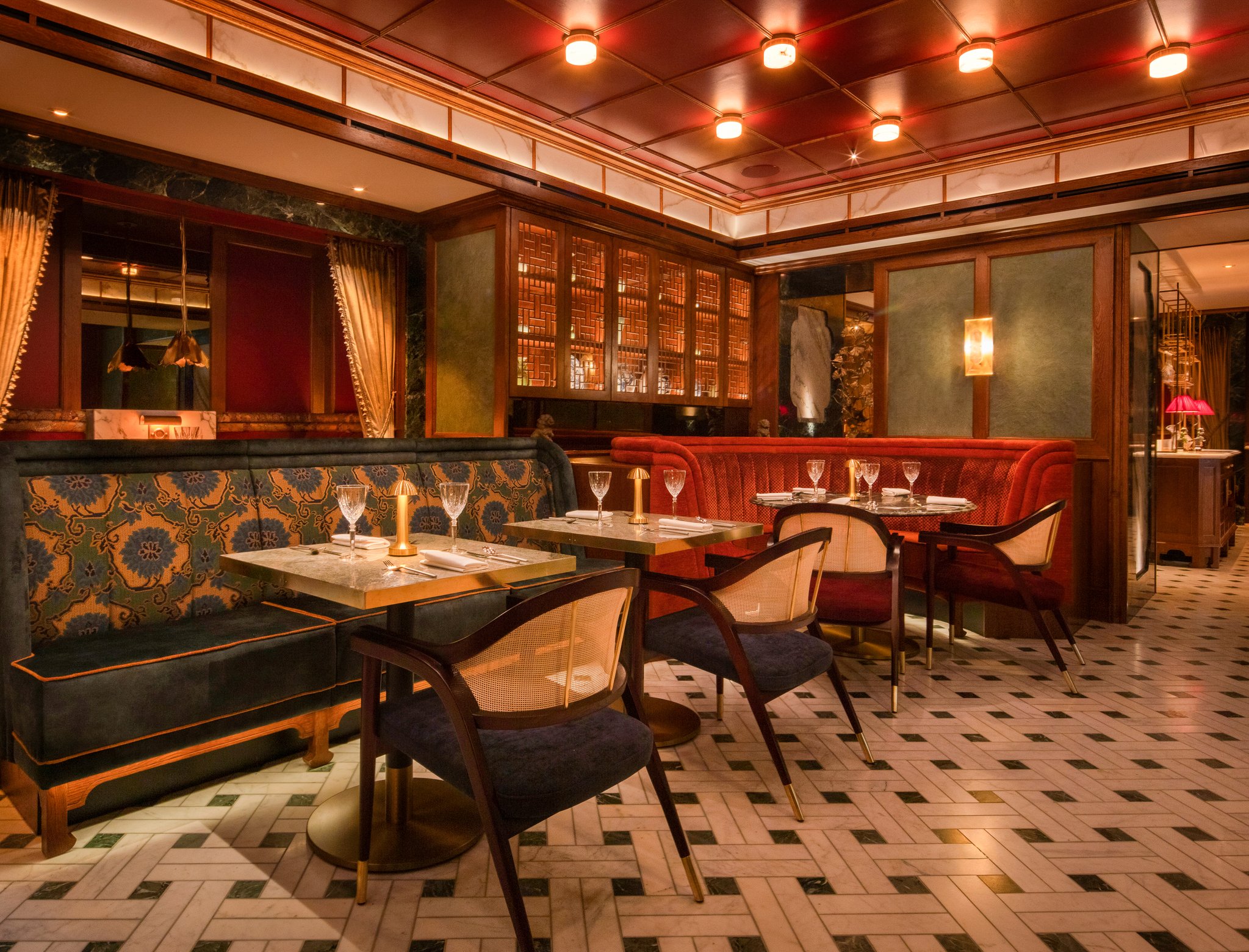
House of Ming, St. James' Court, A Taj Hotel.
We step inside a grand entrance, flagged with tall sculptures of gilded ginkgo leaves illuminated by softly glowing red and gold paper lanterns, or dēnglóng, to be met with a lavish floral display shrouding the dining area beyond. Signifying resilience and perseverance, tall fronds of plum blossom are hung with red knotted decorations, or zhōngguó jié, to embody luck and prosperity, whilst red chrysanthemums represent joy and vitality, inviting good fortune.
As we are shown to our seats by Robin, who astutely looks after the team front of house and introduces us to the evening ahead, we walk beneath a ruby-red-lacquered ceiling, and past walls panelled in mahogany-toned wood inlaid with deep, mottled green, adorned with custom-made artwork. Our destination is a private love seat of red velvet and gold brocade, flanked by thick gold silk curtains, where a solid marble table is illuminated by a single, oversized ginkgo blossom hanging from the ceiling. It really is striking: unique and formal, yet cosy and romantic.
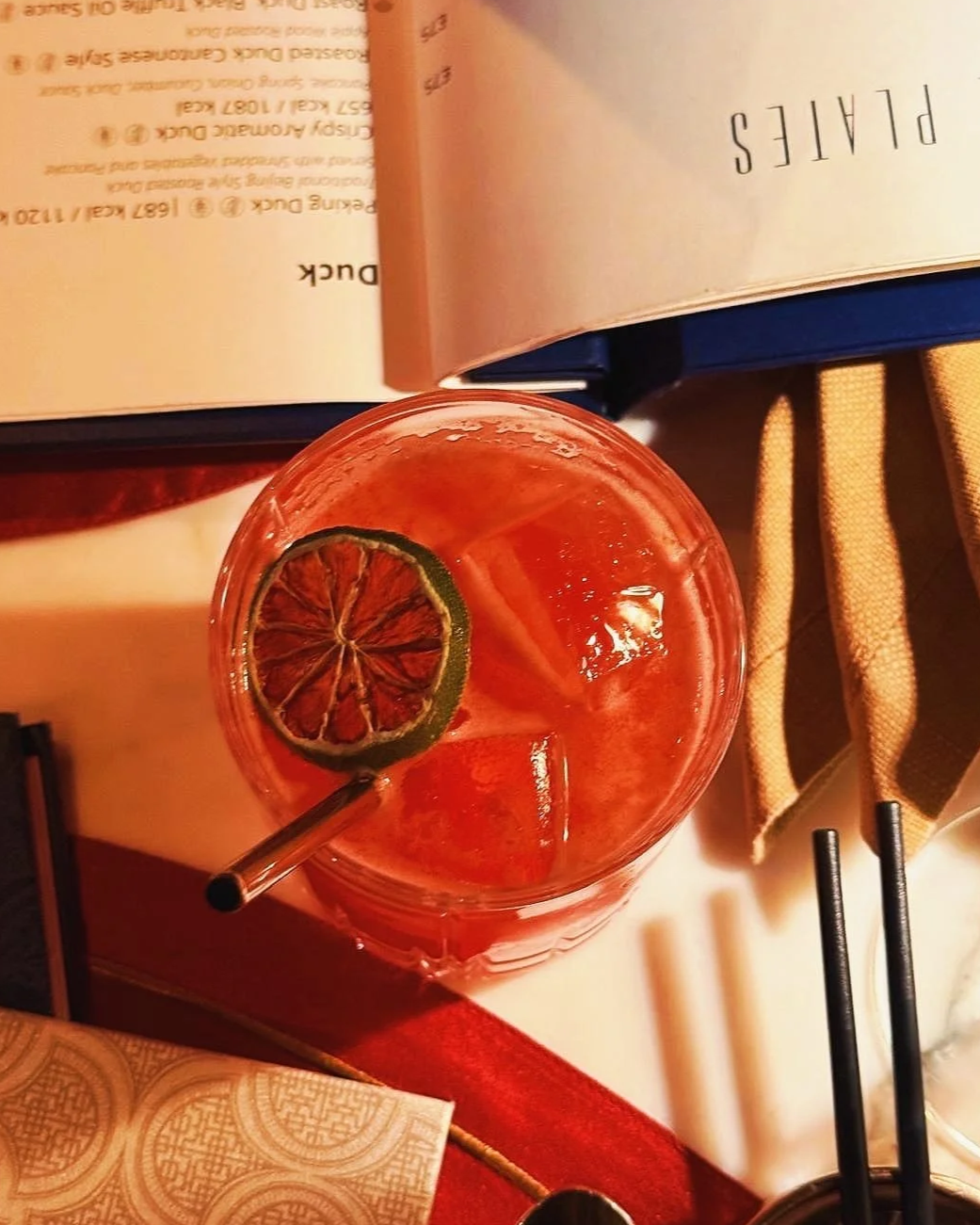
‘Inferno Ride’, inspired by the year of the Fire Horse.
As we sip our cocktails: a flawless margarita and the ‘Inferno Ride’, inspired by the year of the Fire Horse, with Chinese five-spice-infused baijiu, Campari, sweet vermouth and rhubarb bitters, an adventurous twist on the Negroni profile; we linger over the vast menu. To start, we consider almost twenty varieties of dimsum, including spinach, almond and golden garlic, and pork prawn truffle sui mai. These sit alongside traditional soups and exceptional-looking small plates, such as the crispy chilli garlic octopus, the lamb wonton with sichuan garlic and the venison and onion puff.
We find the dim sum particularly compelling and order the mushroom and truffle, where a creamy cheese filling harmonises with the dish's inherent earthiness; and the edamame with smoked chilli, where we find a beautiful fellowship of aromatics in smoked chilli oil, ginger, garlic and coriander, garnished with a single edamame bean. The scallop with golden garlic is truly outstanding, with sweet prawn and scallop meat, an uncomplicated seasoning of fried garlic, and is exquisitely presented, topped with tiny jewels of caviar.
We decide on lotus stem with honey and chilli to accompany our dimsum, with slivers fried in a sweet, warming sauce; whilst warm, sticky and crunchy, and when cool, brittle and candied, either way, light, delicate, and oh-so pretty. The drunken fish was perfect alongside, with tender slices of lightly battered sea bass in an aromatic, clear baijiu sauce seasoned with ginger and thick, warming slices of mild red chilli. As we dine, an ethereal soundtrack of ambient beats and movie soundtrack bites, like Hans Zimmer's ‘Cornfield Chase’ from Interstellar, plays across the space.
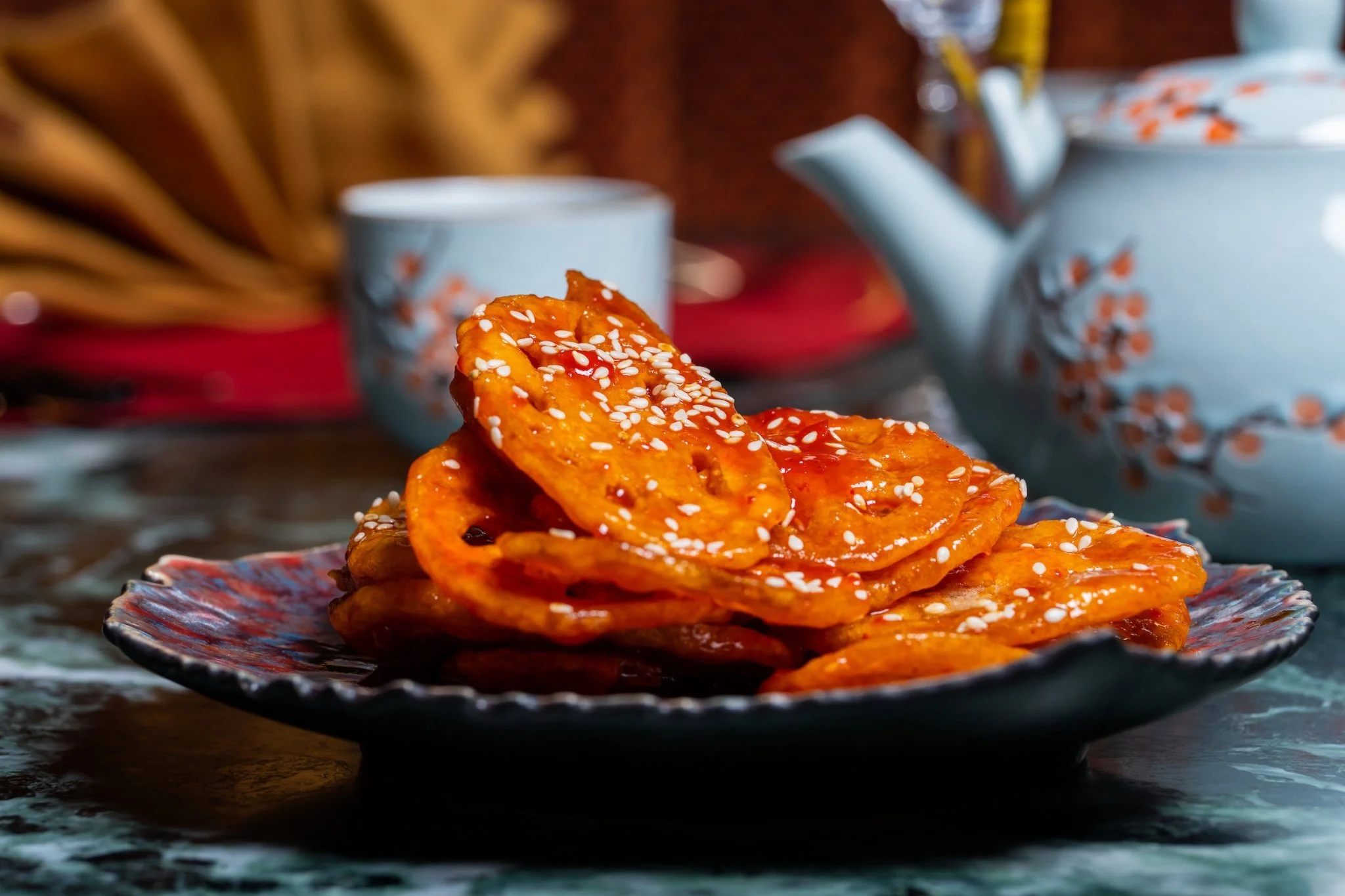
Lotus stem with honey and chilli
The new year heralds a special menu of seasonal mains, as head chef Dixon later explains, ‘We designed this menu around colour, texture and flavour to complement the fire element’. The selection showcases dishes like typhoon shelter fried crab, a historic Hong Kong dish prepared with dry red chilli and garlic, now a fine-dining centrepiece, reimagined with Alaskan king crab leg, and the pan-fried rack of lamb in a sweet-and-savoury honey-and-black-pepper sauce.
We fix on the three treasure seafood in XO Sauce, featuring arctic surf clam, scallop and king prawn, all velvety light, with contrasting yellow bell pepper and asparagus cooked to perfect firmness, in a satiny, spicy sauce. We are advised by the wonderful Nandu, who caringly looks after us for the evening, that, despite our already sufficing plates, the aromatic duck is a chef's speciality we really must try. Correct, of course, the five-spice-marinated meat comes crisp and shredded, yet succulent and full of umami; its classic accoutrements of pancakes et al., all that is required for the flawless bite.
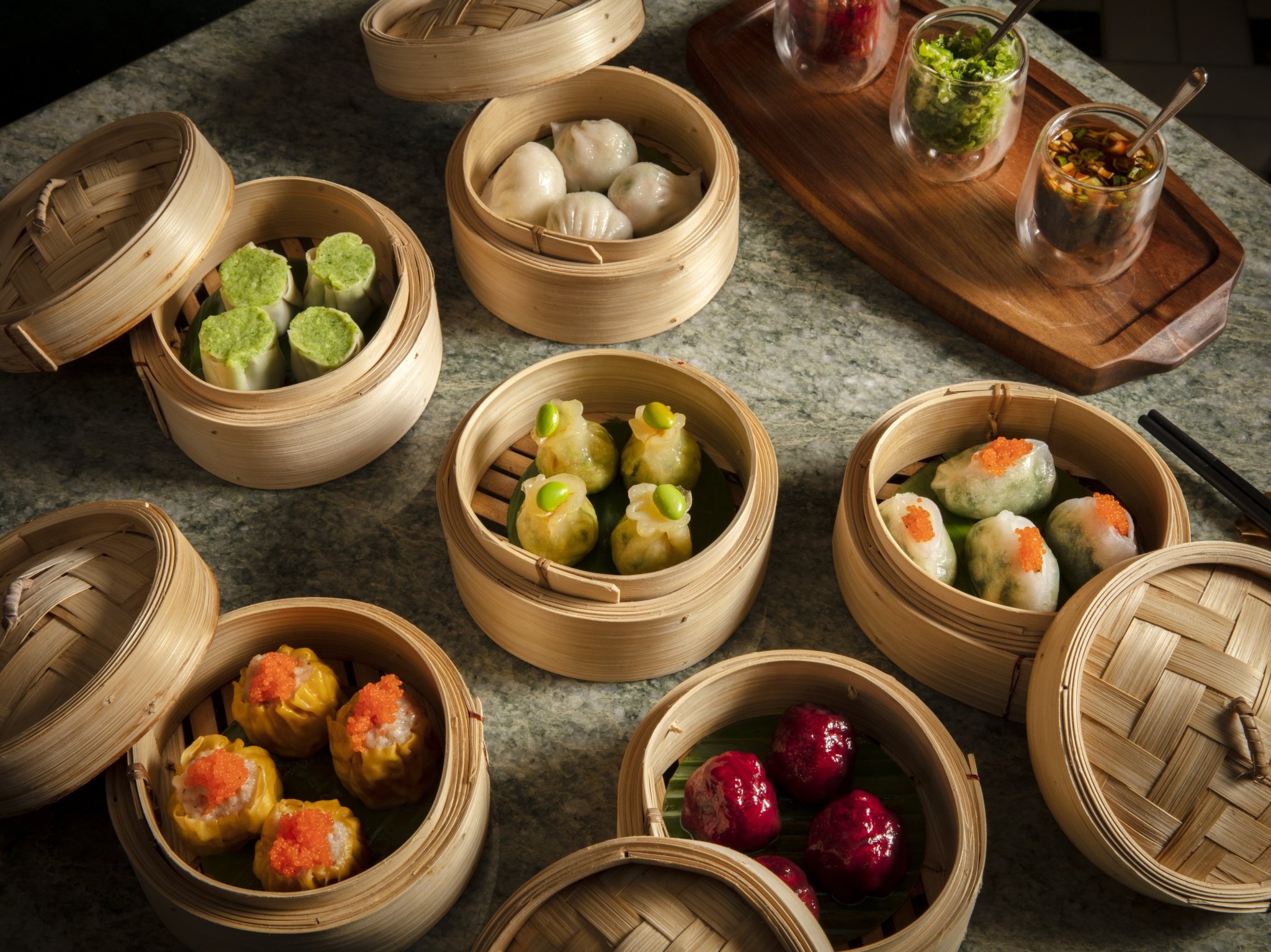
Exceptional dim sum.
As we can’t fully curate our mains without sides, we take the stir-fried Chinese greens, a verdant jumble of tender stem broccoli, asparagus, cabbage and snow peas, in a light, silky, clear gravy with smoky minced garlic. We finish up our order with the moon fan rice, a traditional Sino-Mauritian mushroom rice dish using five-spice.
With absolutely no space for dessert, despite their calling of lime and yuzu mousse, with lemon compote or stem ginger sorbet, their Tea Sommelier is a must, with a selection of hand-selected speciality teas to round off our night.
Overall, the menu is really expansive and exciting, even before prospects consider their dim sum brunch or the Imperial Dining menu, designed to unite traditional and modern styles of Sichuan and Cantonese cuisine. Whilst the restaurant creates a perfect setting for two, the temptation to order more feeds the desire to return with a large table, to share and indulge in even more of the delights and delicacies.
