
Palais Amani, Fes Review: A City Of Two Tales
After a panoramic drive through open countryside at sunset, we dip down into Fes el-Bali medina, entering through a slim, easily overlooked opening between buildings, to traverse a centimetres-wide alleyway hemmed in by high, triple-story walls of the neighbouring buildings.
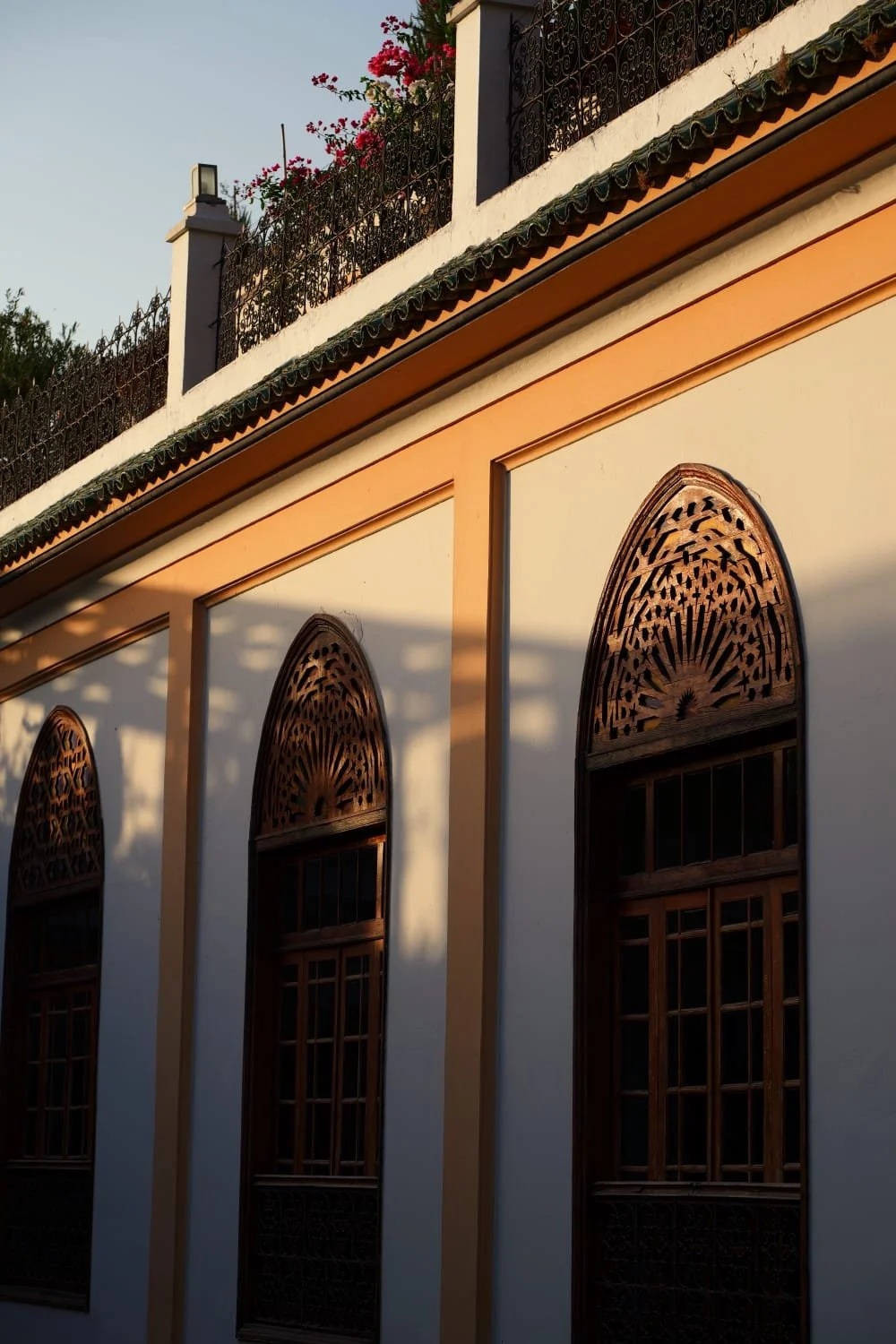
Stained glass windows line each hallway above the central courtyard, with a rooftop garden above.
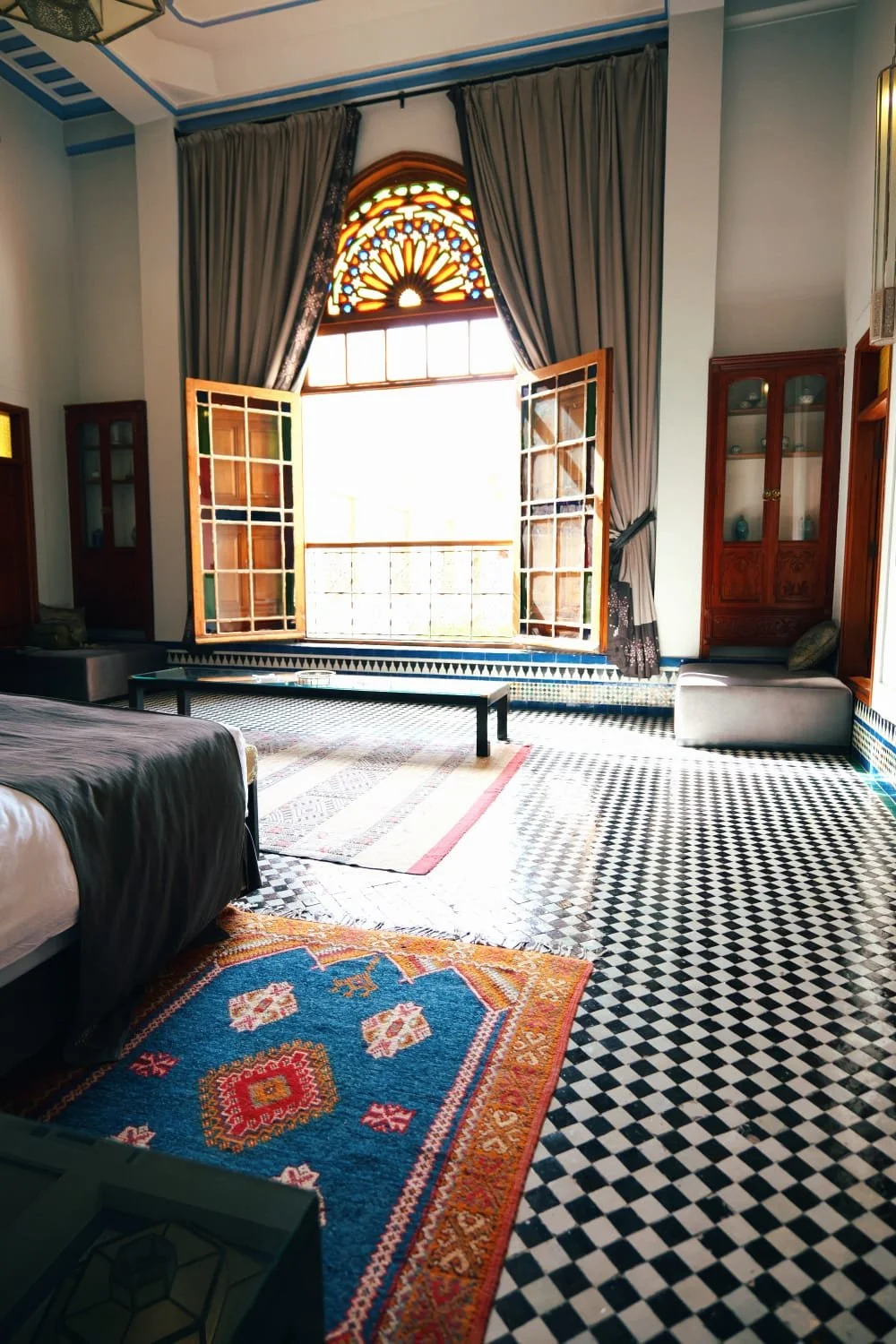
The Grand Suite, with its balcony and stained glass windows.
As is often customary, a guide from our destination meets us, accompanying us through the narrow, winding streets. Doorway stores spill over thresholds where locals perch on their stoops, sipping mint tea as children rush by, pausing every now and again to greet the street cats. Even in the final part of our journey, just after dusk, we find the ancient town is still a hive of activity.
After a few minutes' stroll, we arrive at Palais Amani on the northern edge of the old town. As we step over the threshold through a grand, intricately carved wooden door, we are led through a homely vestibule before the grand interior reveals itself.
An otherworldly open-air courtyard is uplighted against the fading sun. Detailed zellige tilework in tones of Fes blue, white, and ochre yellow stretches across the ground, reaching up lofty columns and climbing over neat planters. A verdant, luscious parterre, seemingly forgetful of its enclosed walls, is abundant in citrus trees and rich in foliage, from umbrella plants to bird-of-paradise. Any thoughts of the outside world melt away in an instant, with the whisper of the fountain lying at its centre.
We are welcomed by Abdul, who graciously handles our check-in as we sip mint tea. As he leads us to our room, he shows us around the majestic space, revealing how elements of its history entwine with its modern-day use, drawing on his knowledge from eight years at Palais Amani.
Once a lavish, riad-style residence of the Lahlou family built in the 17th century, extensive damage by a landslide led to a two-year renovation project starting in 1928. Perhaps inspired by their merchant links in sugar and cotton between Manchester and Fes, whilst protecting the building's heritage, there is also a nod to Art Deco design, contemporary to the era of the rebuild.
After centuries of the Lahlou family living together, with up to 50 extended family members cohabiting, many were no longer resident in the run-up to its 2006 sale. Much in need of love and restoration, the palace, now a listed historic building, was treated to a tender three-and-a-half-year renovation programme by its present owners, another Anglo/Moroccan alliance, to step into its new appointment as a 21-room boutique hotel and cooking school.
At an impressive 100 m², the Grand Suite was previously an interconnected living space of salons and dowager rooms. Opening into a demure reading room and office, it comprises a through bedroom with a king-size bed and his-and-hers dressing rooms. Off the bedroom, an elegant bathroom space offers a bath for two, a dressing table overlooking the courtyard, a separate shower and second washroom.
Not yet turned down for the evening, an immense stained-glass window over the bedroom's Juliette balcony awaits the morning to show us its true potential, whilst delicate light plays off the vaulted ceilings and trickles through shuttered doors from huge metal lanterns, uniting the space.
As we make our way to a late dinner, we tread softly through the halls, the gentle sound of dining still echoing from below. Housed within the leafy courtyard, Restaurant Eden is the beating heart of Amani, creating a focal point where one craves to linger at any time of day. Open to residents and non-residents alike, the restaurant hosts a menu of traditional yet refined dishes, with ingredients sourced from the nearby souks or the rooftop garden.
Our candle-lit table magically fills with warm Moroccan buns dusted with semolina, a medina’s worth of infused olive varieties and piquant, crisp pickled market vegetables, before an amuse-bouche arrives. A chilled broth, reminiscent of clarified gazpacho, is speckled with glossy olive oil, topped with a chunk of brined Sardine, and garnished with radish, pickled red onion, home-grown micro marjoram and sesame.
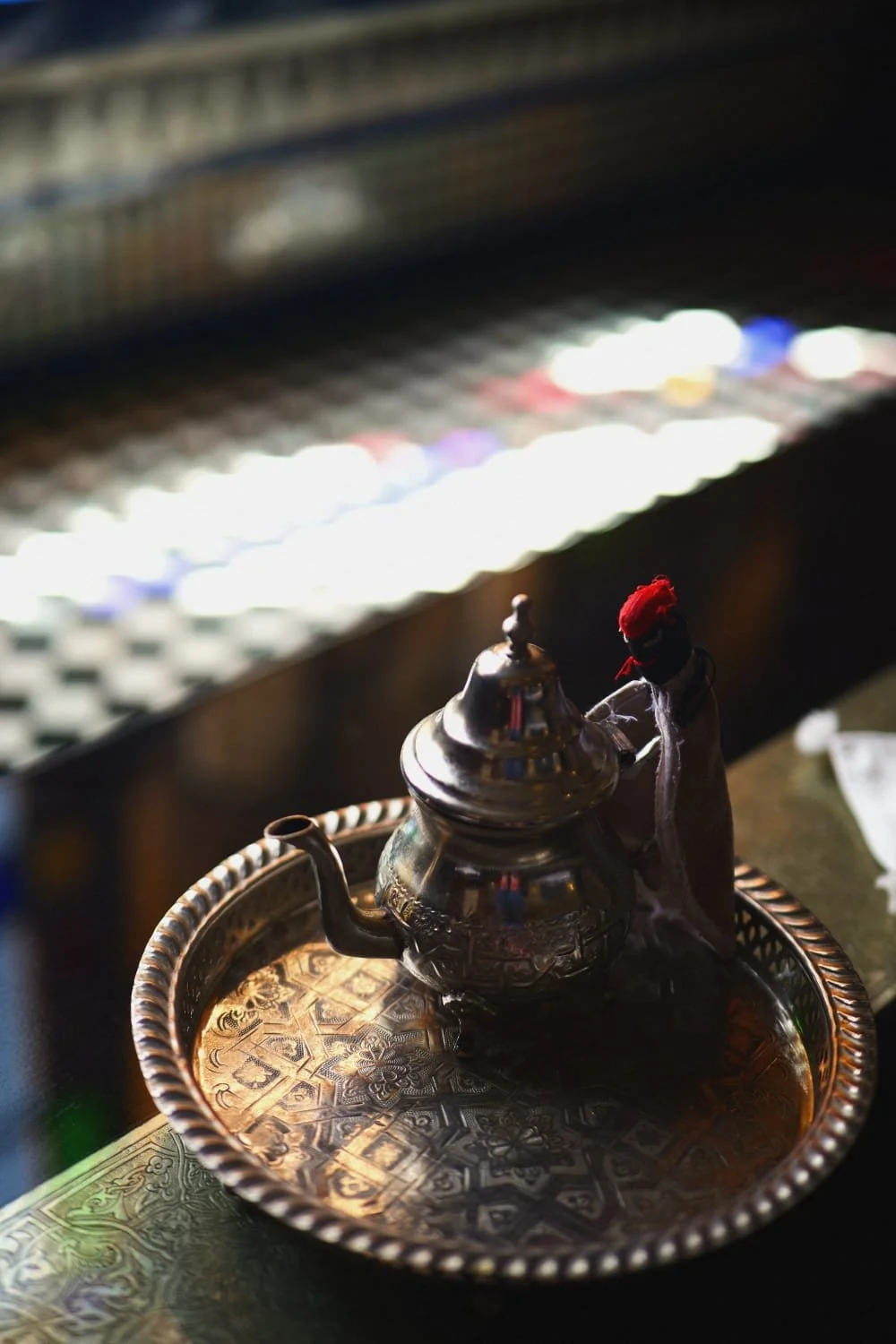
Mint tea, served in a traditional berrad, or metal teapot.
As we dine, the scent of orange blossom and sandalwood drifts through the air, with a soundtrack of roosting doves and the ever-present murmur of the fountain. Nearby, the gardener strolls quietly on his nightly visit to tend to the greenery, as our server smiles at him and shares with us, “He treats it with the same care he offers his children”.
An onion soup creates a refreshing opening, perfectly balanced between sweet and savoury. With a herbal finish from more home-grown rosemary, it pairs excellently with the accompanying traditional spiced pastries. With tajine on the mind for days prior, our savoury spread is finished by the arrival of tender chicken falling from the bone, cooked with traditional spices of cumin, ginger and chilli and a dish of steamed sea bass atop braised vegetables in a herby broth; both finished with braised olives and garnished with preserved lemons. Served with chilled Spéciale Flag, a local beer, it was the perfect tonic to a day of travel.
It’s a menu that knows its roots and is comfortable in perfect execution, emblematic of Morocco's connection to the sea, agriculture, and historic spice production. Honestly, the amuse-bouche alone could rival any Michelin-star-worthy dining experience elsewhere.
Despite the struggle for space, we couldn’t miss a decadent dark chocolate mousse before we drifted sleepily back to our room, carrying delicate glass cups brimming with verbena tea.
The next day, we draw the immense curtains at first light to imbibe the view from the balcony, over the rooftop yoga class to the hills on the horizon. Experiencing magical glimmers of a bygone century, colourful shadows in worshipful colours fall through the Iraqi stained glass, the call to prayer, or the adhan, rings in the air, and house sparrows dip in and out of our suite to forage, as we sip our morning coffee in bed.
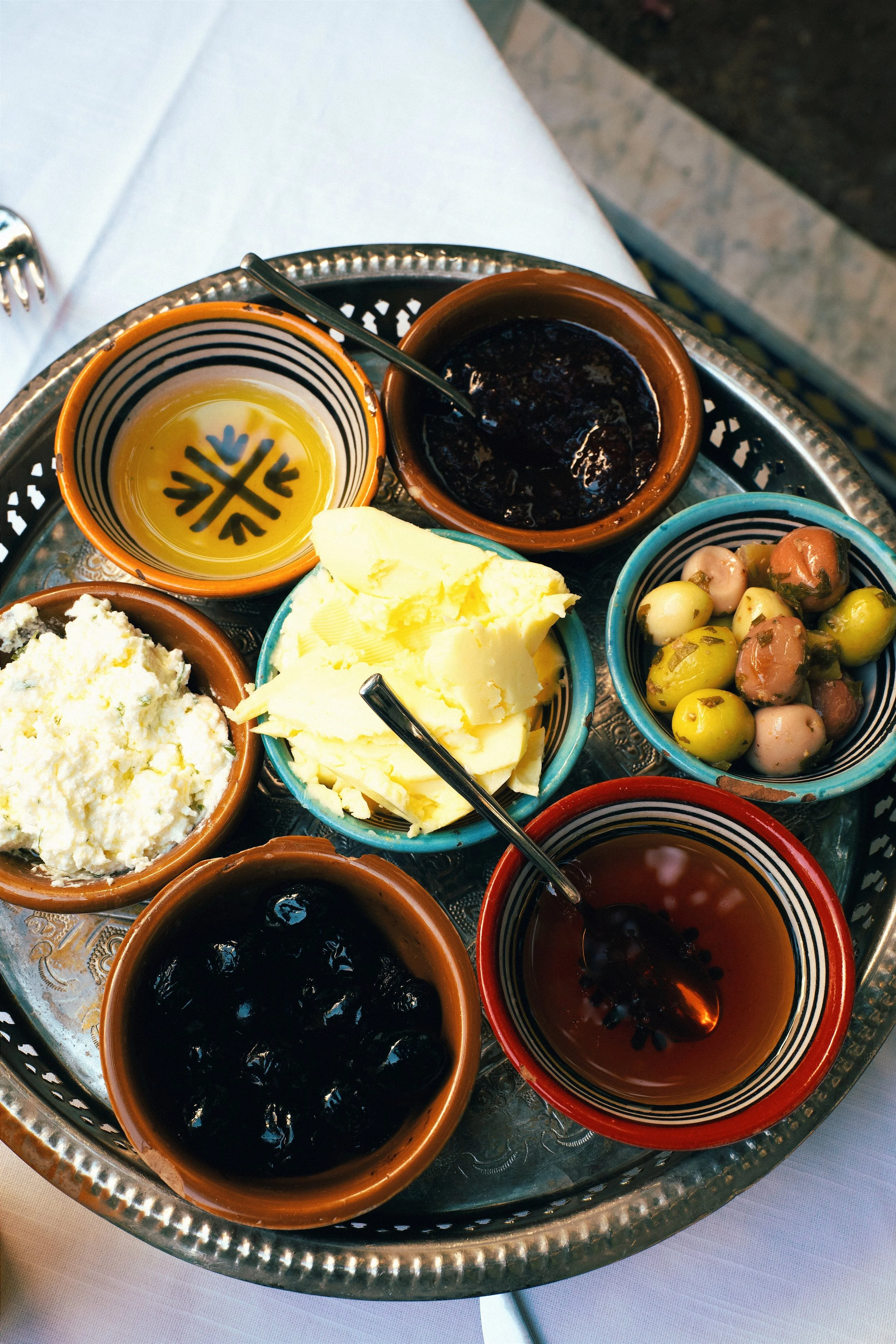
Colourful sides to breakfast.
Breakfast is a leisurely affair. Expect table service of the dishes du jour, from bessara, a local dish of fava bean soup seasoned with cumin and salt, a rich, earthy, and comforting dish surprisingly light for breakfast, to spiced vegetable soup with chickpeas. Lashings of msemmen, a traditional, layered, light-yet-buttery flatbread, sometimes filled with meats or vegetables, will accompany a side of harcha, a heavier, pan-fried semolina griddle cake with a moist crumb.
Alongside, you’ll find fresh fruit salad, homemade strawberry jam, golden local butter, olives, honey, and jben, a soft, spreadable, and slightly tangy fresh cheese of raw goat’s and cow’s milk, Morocco’s national cheese.
Moroccan coffee is a must-try: a dark-roasted bean infused with ground cinnamon, cardamom, ginger, cloves, nutmeg, and black pepper. As is their tea; served with fresh mint and sugar, gunpowder green tea creates an invigorating refreshment. Whilst servings tend to get stronger as the day goes on, you can request how sweet or light it is, as per your preference.
On our first day, we take a walking tour through the medina, led by our guide Rachid. The medina of old town Fes, or Fes el-Bali, is an impressive UNESCO World Heritage site, for multiple reasons. Established in the 9th century, it’s one of the world's largest and best-preserved showcases of medieval town planning, yet remains a living city with around 65,000 residents.
Even for the seasoned traveller, the first moments in the medina can be jolting, as this labyrinth of over 9,000 narrow alleyways creates a complex maze around you. And yet, on closer look, as the medina opens its heart to you, you realise this seemingly rough-hewn stone has been refined over centuries into a bejewelled treasure. By a community of craftspersons, with an ancient focus on education, a dynamic, welcoming and beautiful city has grown, whilst remaining deeply in touch with, and proud of, its heritage.
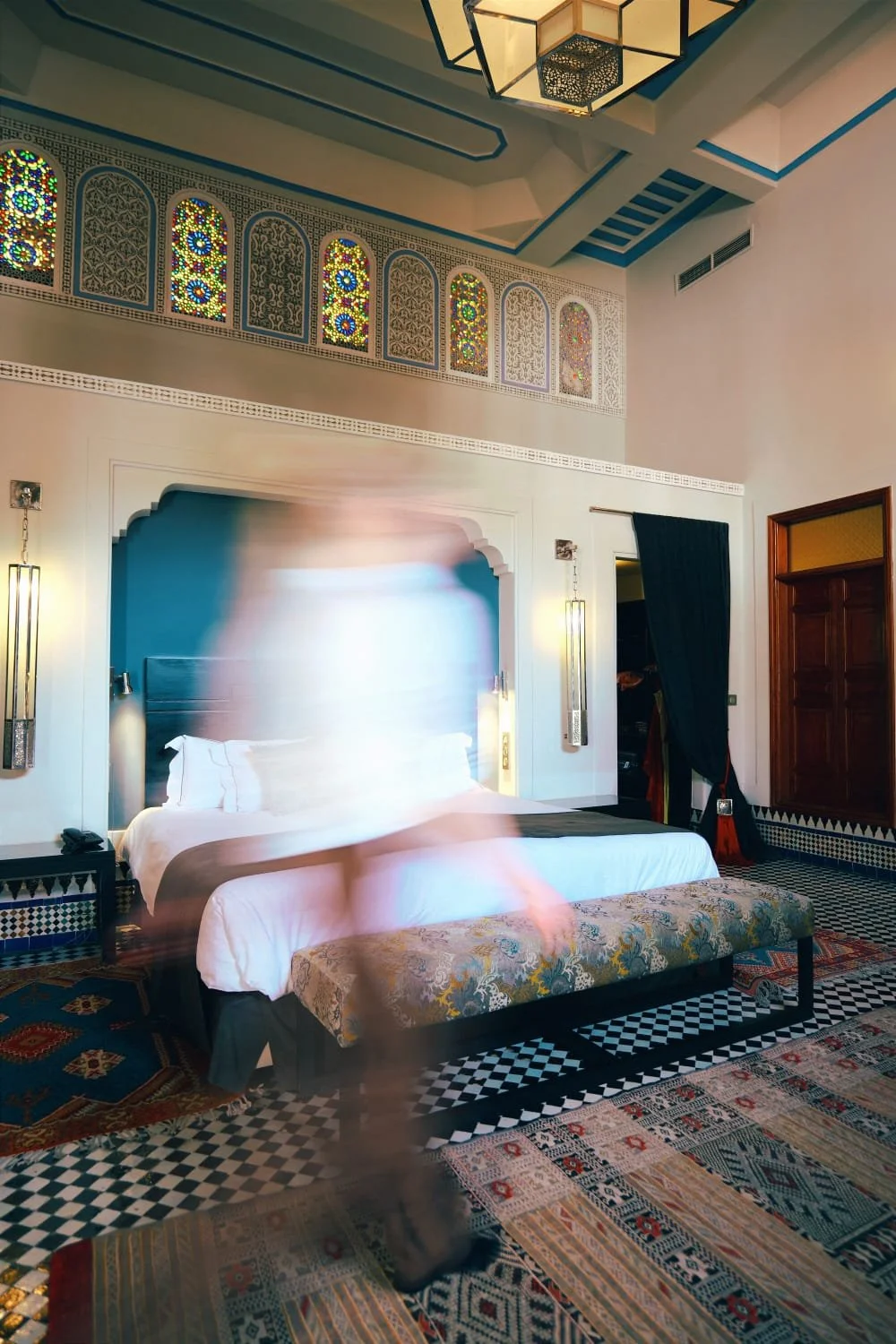
Stained glass windows and lanterns in the Grand Suite.
Two incredible hours, three film rolls, four large shopping bags and five miles later, we return to the palace. From the bracing bustle of the medina, there is a quiet mysticism in how Amani gently envelops you in a sancteous calm. With each step inside from the beat of the city, the grip on every sense the world beyond the walls holds is forgotten.
On our return, Meryem and Soukaina in front of house ensure that a late lunch is available for us, as they ask about our day. Full of knowledge on every request, they seamlessly arrange our excursions for the next couple of evenings.
Whilst open-air dining becomes the enduring choice for our stay, a few indoor spaces leading from the courtyard offer respite from an afternoon with too much heat. At the front of the building, the library retains its former use, whilst also housing the bar. The dining room, formerly the grandparents' suite, sits at the back of the building, behind the wellness spaces for massage and hammam.
The stacked hallways overlook the courtyard gardens as you wind your way up to the rooftop lounge and the cooking school, where we spend another afternoon learning traditional recipes. You’d think the heat of a rooftop kitchen would be too much on a midsummer afternoon, and yet the open workspace and lofty breeze kept us comfortable as Chef Oussama and Chef Meryem guide us through each dish. We prepare our first tajines alongside side dishes like zaalouk, or eggplant and tomato salad, before feasting on our creations over a late lunch.
Whilst visiting, a true hammam experience should not be overlooked, and indeed, the hammam at Palais Amani is open to visitors staying elsewhere seeking a luxury experience of this centuries-old ritual.
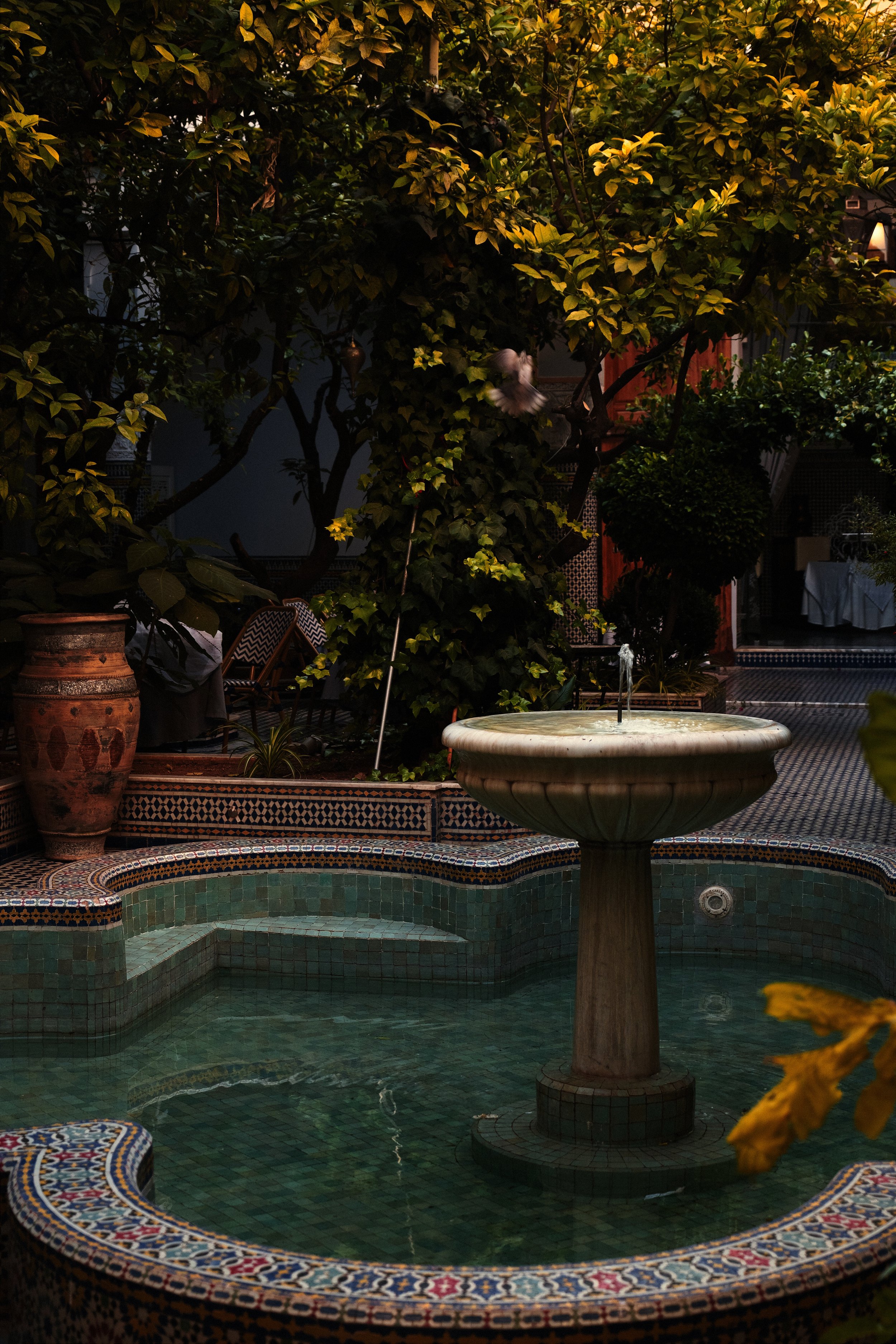
Reflections and symmetry in the courtyard fountain.
Located below the kitchens, the steam cocoons you with each step closer to the cellar, carrying the delicious scent of orange blossom. After undressing to my comfort level, I’m invited to soak my hands and feet in a copper basin, or tassa, of hot water garnished with bougainvillaea flowers. As I sit, my hands, arms, feet and calves are exfoliated with ground wheat then rinsed by a deft and kindly kessala, a female bath attendant, in a steam-filled annex.
Next, I’m invited to move to a larger room, where piping-hot water overflows from a basin, creating yet more fragranced steam. With stone beds on which to recline, I am gently doused in hot water from head to toe, then marinated in olive oil and eucalyptus-infused black soap. After rinsing, I am then scrubbed to an eye-opening level of hygiene and softness that I fear I will never be able to re-create at home.
In a body mask of ghassoul clay, I am left to float to a higher plane on the vapours of orange blossom oil and eucalyptus, when after an indeterminate amount of time (possibly five to ten minutes) I stumble headily to the shower for a final rinse.
Our last evening is spent atop the roof once more; a handsome space to watch the swallows dance on the zephyr to the adhan, survey the still-vibrant streets below to people-watch or recline on the day beds to study the storks escorting the sun below the horizon.
By an early flight the next day, we are torn from the cocoon of relaxation and reluctantly say goodbye. It’s the end of my first trip to the area, but it has incited a love for Morocco that will endure.
For more information, visit Palais Amani.
